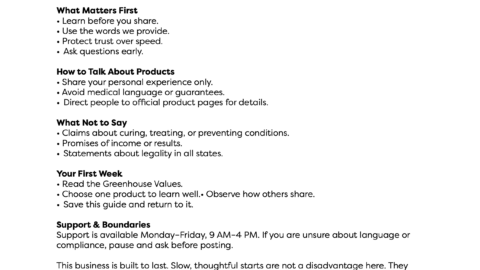
Day 8 — How to Talk Without Convincing
Most new ambassadors believe their job is to persuade.
It isn’t.
Your role is to present clear information about a product you trust, answer questions honestly, and allow the other person to decide.
If you feel like you are pushing, chasing, or trying to overcome objections, you are likely operating outside alignment.
1. Understand the Difference: Education vs. Persuasion
Education says:
- “Here’s what it is.”
- “Here’s how it works.”
- “Here’s who it’s for.”
- “Here’s who it’s not for.”
Persuasion says:
- “You need this.”
- “Trust me.”
- “Don’t miss this.”
- “Just try it.”
At Botanic, we lead with education.
Why? Because long-term trust matters more than short-term sales.
2. Why Convincing Backfires
When someone feels pressured:
- Their guard goes up.
- Their skepticism increases.
- Their trust decreases.
Pressure creates resistance. Clarity lowers resistance.
Your calm posture communicates confidence. If you appear desperate for the sale, people assume there is something to be cautious about.
Confidence sounds steady. Desperation sounds urgent.
We choose steady.
3. The Practical Framework: Share → Clarify → Release
Use this three-step model in conversations:
Step 1: Share
State what the product is and what it’s designed to support.
Example:
“It’s a plant-powered topical designed to support muscle comfort. It’s formulated with botanical ingredients and lab tested for consistency.”
Keep it factual. Avoid promises. Avoid outcomes.
Step 2: Clarify
Answer questions directly and simply.
If you don’t know, say:
“That’s a great question. Let me confirm that for you.”
Clarity builds credibility.
Step 3: Release
Close without pressure.
“If it feels like a fit, I’d love to help you get started. If not, no pressure at all.”
This communicates security. Security attracts.
4. Watch Your Language
Remove these phrases:
- “You have to try this.”
- “It works for everyone.”
- “This will fix…”
- “Don’t wait.”
Replace them with:
- “Many customers appreciate…”
- “It’s designed to support…”
- “It may be helpful if…”
- “Take your time.”
This protects compliance. It also protects your reputation.
5. Detachment Is a Skill
Detachment does not mean you don’t care.
It means:
- You are not emotionally tied to the outcome.
- You are not measuring your worth by someone’s decision.
- You are not chasing.
- You are offering.
That is a position of strength.
6. How to Know You’re Aligned
After a conversation, ask yourself:
- Did I stay calm?
- Did I tell the truth?
- Did I avoid exaggeration?
- Did I leave the decision with them?
If the answer is yes, you did your job.
The right people do not need convincing. They need clarity. Choose clarity.