
What Upholstery Cleaning Codes Mean Before You Touch a Stain
August 14, 2026
A spot on a sofa can make the nearest bottle look like the obvious answer. Upholstery asks for a slower first step. Before you spray, scrub, or add water, find the furniture maker’s care tag and read the entire instruction.
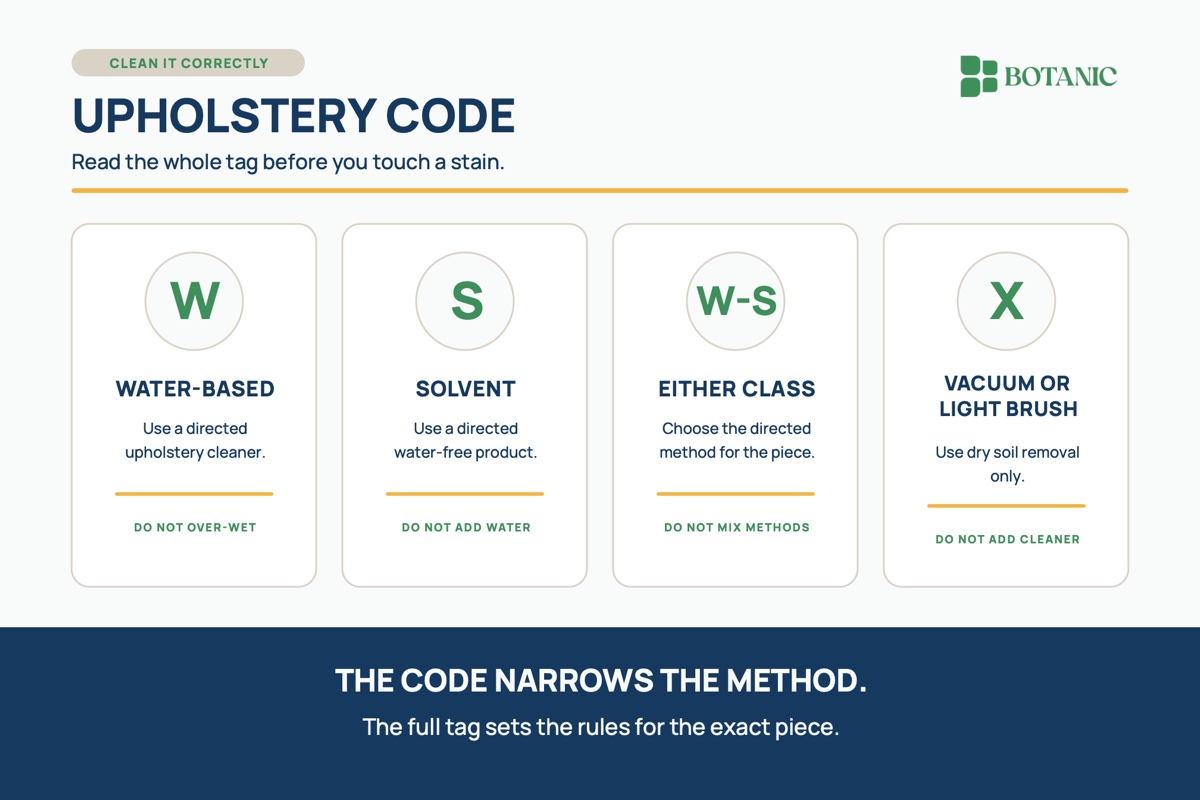
Many fabric-covered pieces use a letter code such as W, S, W-S, or X. The code narrows the type of cleaning method the upholstery is designed to receive. It does not identify the fabric by itself, promise that a stain will come out, or turn every product in the permitted class into a good choice.
Find the exact directions for the exact piece
Look beneath a removable seat cushion, under the platform that supports the cushions, or on the underside of the furniture. Some makers also place care information on the product page, order record, or warranty document. Read all of it, including words beside the code, because one manufacturer may add limits that another does not.
Confirm that you are reading the upholstery care tag rather than a law label, fiber-content label, or cushion-fill label. A code for the outer fabric may not cover leather or coated panels, decorative trim, wood, metal, zippers, backing, cushion interiors, stain-protection treatments, or previous repairs. Removable cushion covers are not automatically machine washable or suitable for separate dry cleaning just because they have a zipper.
W means a directed water-based method
A W code generally allows the water-based upholstery shampoo or foam cleaner specified by the maker. It does not mean that the piece can be soaked, steam cleaned, rinsed freely, or treated with any household product that contains water. Ashley’s current furniture-care guidance, for example, tells owners of W-coded fabric not to over-wet it and not to use a solvent for spot cleaning.
Use only a product and application method permitted by both the furniture directions and the cleaning-product label. Keep the amount controlled, work with a clean white cloth when the directions call for one, and avoid spreading moisture into seams, padding, wood, or hardware.
S means a directed water-free solvent method
An S code generally permits a water-free dry-cleaning solvent intended for upholstery. It does not authorize an improvised household solvent, a homemade mixture, or a water-based cleaner used sparingly. The exact solvent product must name the intended use, and every ventilation, ignition, protective-equipment, storage, and disposal direction on its label still applies.
Solvent work is a sensible place to choose a qualified upholstery professional when the maker recommends one, the stain is large, the room cannot meet the product’s ventilation directions, or you are not equipped to apply and recover the product exactly as directed. More solvent and harder rubbing do not make the method safer or more effective.
W-S means either class may be permitted
W-S, also written SW or WS by some makers, generally means that a directed water-based upholstery cleaner or a directed water-free solvent may be used. It does not mean that the two should be mixed, layered, or tried one after the other without guidance.
Choose the method from the full furniture instructions and the stain situation, not from whichever product is closest. If the maker names a specific cleaner, procedure, or professional service, that direction is more useful than the letters alone.
X means keep liquid cleaners away
An X code generally limits routine care to vacuuming or light brushing. Ashley’s guidance says not to use either a water-based cleaner or a solvent-based cleaner on X-coded upholstery. A fresh spill can still be blotted with a clean absorbent cloth to lift surface liquid without rubbing, but do not add a cleaning solution unless the exact maker directs it.
If an X-coded piece has a stain that dry soil removal cannot address, contact the manufacturer or a qualified upholstery professional before proceeding. The same pause is appropriate when the tag is missing, unreadable, contradictory, or clearly belongs to a different component.
Test the complete permitted method
Even a permitted method can change color, texture, pile, sheen, or the edge of a cleaned area. Follow the furniture maker’s testing directions. If the maker allows an inconspicuous test, use the exact cleaner, dilution, cloth, amount, motion, extraction, and drying conditions you plan to use on the visible area.
Let the test dry completely before judging it. Check for dye on the cloth, fading, darkening, rings, stiffness, tackiness, flattened pile, roughness, odor, or a visible boundary. A passing test reduces uncertainty, but it does not guarantee that a different stain, larger area, seam, backing, or cushion interior will respond the same way.
A five-step pause before stain treatment
- Blot, do not scrub. Lift fresh surface liquid with a clean absorbent white cloth while you locate the care information.
- Read the entire tag. Identify the code, the words beside it, the component it covers, and any named product or professional-care direction.
- Match both sets of directions. Use a cleaner only when the furniture instructions and the cleaner label both permit the material, method, and intended use.
- Test and dry. Test the complete permitted method in an inconspicuous area when the maker allows it, then wait until it is fully dry before deciding.
- Stop when uncertainty grows. Choose professional guidance for a missing code, delicate or mixed construction, unstable dye, a large or old stain, contamination below the fabric, previous treatment, valuable upholstery, or a warranty concern.
The useful rule is not to memorize a bottle for every stain. Memorize the pause: find the tag, read the whole instruction, and let the code narrow your next step. That small decision protects the furniture from a hurried treatment that may be harder to undo than the original mark.
Treat the code as a boundary
A code tells you which general treatment family the maker permits. It does not identify every fiber, finish, dye, backing, cushion interior, or stain, and it does not guarantee that a home treatment will remove every mark.
Photograph the tag, identify the stain without rubbing it farther into the fabric, and test the complete permitted method in an inconspicuous area. Stop for color transfer, texture change, water marking, a missing code, a delicate construction, or a stain that needs professional assessment.
Do not substitute a hard-surface cleaner for upholstery guidance simply because the label sounds versatile. The surface and maker instructions come first.
With care,
Hazel