
When It Seems to Rain Butterflies
October 13, 2026
Fall does not arrive in Spicewood according to a tidy calendar. October can still be hot. Halloween may bring a cool snap, or it may feel like summer has refused to leave. I do not trust sweaters, pumpkins, or a date on the page to tell me the season has changed.
I trust the butterflies.
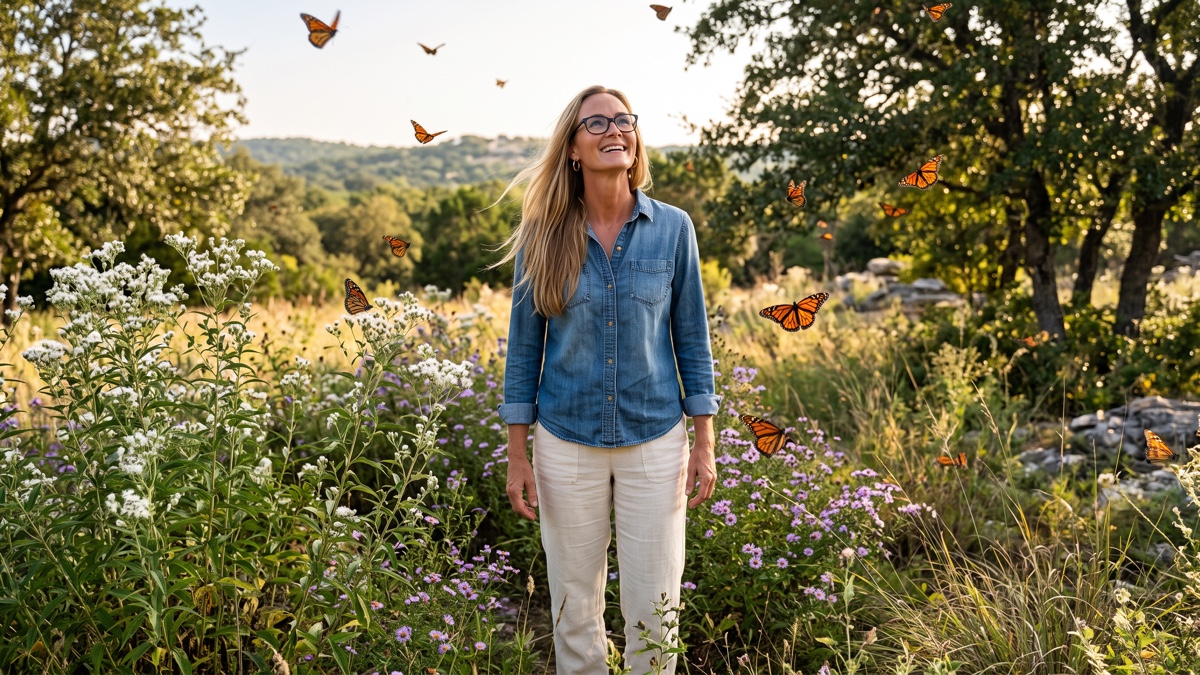
There are October days in Texas when so many butterflies move through that it can seem as though the sky is raining them. I have experienced it many times, and the sight never becomes ordinary.
Texas is part of the journey
Each fall, monarchs from farther north travel through Texas on their way toward overwintering grounds in Mexico. Texas Parks and Wildlife describes the state as a critical bridge between northern breeding areas and Mexico. One major flyway crosses a wide section of the state, while another follows the coast later in the season.
Timing changes with latitude, weather, and wind. Monarch Watch’s general timing information places peak abundance near our part of Texas in early to mid-October, but a cold front, heat, or changing winds can shift what any one person sees. Nature does not owe us a performance on schedule.
That uncertainty is part of why paying attention matters. The migration is not scenery arranged for us. It is a living movement we are fortunate to witness.
A tradition of watching
My mother and I have tracked the migration together over the years. We watch the movement south and look for reports of where the butterflies are appearing. I do not remember which specific website we used in every season, but Journey North now offers community-science maps where people can report adult monarchs, peak migration, and overnight roosts.
When my children were younger, I taught them about the monarch life cycle one October. I made a detailed colored-pencil nature sketch of the stages. That memory brings together several parts of me that have always belonged together: the artist, the teacher, the mother, and the person who can lose track of time looking closely at a plant or animal.
How to watch without making the moment smaller
A migration does not need to be turned into a checklist, but a little preparation can help us notice it. Spend time outdoors when conditions are safe. Look at flowering areas and sheltered places where butterflies may pause. Use a reputable tracking map to understand the broader movement, and record what you see without assuming every orange butterfly is a monarch.
Observation is more valuable when it remains honest. A dense movement of insects may be visible to weather radar, but a radar image alone does not prove that every target is a monarch. A personal sighting can be beautiful without becoming a scientific claim it cannot support.
Let the season arrive in its own language
October in Central Texas does not need to imitate New England to feel meaningful. Our signs are different. The light shifts. Mornings and evenings occasionally carry a suggestion of cooler air. Birds and insects move through. A front may arrive and leave again.
Then, if we are paying attention, butterflies begin crossing the landscape on a journey much larger than our yard, our town, or our state.
When it seems to rain butterflies, I remember that a season can be changing even when the temperature insists otherwise.
With love and intention,
Jennifer