
Choose One Early-Fall Home Tradition Before the Season Arrives
August 23, 2026
A season can arrive on the calendar before a household has noticed it. Then one afternoon the light looks different, the first cool evening passes, and the box of fall things is still tucked behind three unrelated bins. If you want home to mark the change, choose one tradition now, while there is time to make it simple.
This does not need to become a decorating project or a packed event. A home tradition can be one meal, one walk, one porch task, one act of welcome, or one shared bit of seasonal care. What makes it a tradition is not its size. It is the meaning you give it and the decision to return to it.
Start with what you want the tradition to mean
Choose the purpose before the activity. Do you want to welcome the first cooler evenings, notice what is changing outdoors, prepare the entry for wetter weather, make a familiar food, care for a meaningful object, or gather the household for one useful task? Write the answer in one plain sentence.
For example, “We want to notice the first evening that feels like fall” is a purpose. So is, “We want to prepare the porch together before the weather changes.” Once the meaning is clear, the activity can stay modest. Without that sentence, it is easy to collect appealing ideas that do not belong to your household.
A tradition can belong to one person, a couple, roommates, a large family, or friends who do not share an address. It can be new, inherited, adapted, religious, cultural, or entirely household-specific. If you are drawing from a tradition rooted in a culture or faith that is not your own, learn its context and treat it with respect rather than reducing it to seasonal decoration.
Choose a cue you can actually recognize
“Sometime in the fall” is difficult to remember. Give the tradition a cue. It might be the first Sunday after school begins, the first evening cool enough to sit outside comfortably, the weekend a local orchard opens, the first leaf drop in your yard, or a fixed date that suits everyone’s calendar.
Weather-based cues make room for local climate. A household in Texas may not experience the same seasonal signals as one farther north, and the useful date may change from year to year. Calendar cues are easier to plan, but they may arrive before the weather does. Choose the kind of cue that fits the purpose, then write it where the household already looks for plans.
Keep the cue observable and neutral. “When the house feels ready” asks everyone to make a different judgment. “The first Saturday in September” or “the first evening below the temperature our household chose” gives you something you can recognize without debating whether the season has officially begun.
Design the smallest version you would be happy to repeat
Build the tradition around a minimum version, not its most beautiful possible version. If the idea is an early-fall supper, the minimum might be one familiar soup and bread at the regular table. If it is a nature walk, it might be one loop through a nearby park. If it is shared household care, it might be sweeping the porch, checking the outdoor lights, and putting the doormat back in place.
You can add flowers, invitations, a special dessert, or a longer outing when time and energy allow. Those are optional layers. The tradition should still feel complete without them. A repeatable action has a clear beginning, a clear ending, and a scale the household can manage in an ordinary year.
Decide who participates and what each person is actually agreeing to do. Shared work is not meaningful if one person quietly carries all the preparation and cleanup. For a solo tradition, choose a version that feels companionable rather than performative. A cup of tea on the porch, a seasonal recipe written into a home notebook, or a walk to notice the changing light can be enough.
Keep only what helps the tradition return
Give the few physical pieces a home. A recipe, table linen, serving bowl, porch checklist, picnic cloth, or set of cards can live together in one labeled container or one clearly named digital folder. Clean, dry, and inspect reusable items before storing them, following the care directions for each material. Do not pack food, damp textiles, candles that are still warm, or outdoor items carrying soil or moisture.
If the tradition does not need supplies, keep a short record instead. Note the cue, the minimum action, what worked, what felt like too much, and anything you want to remember next year. A photograph can be part of the record, but it does not have to become the point of the occasion.
Set a limit before shopping. You may already own everything the tradition needs. If something is missing, decide whether it can be borrowed, substituted, made, or left out. The goal is to create a reliable return point, not a new category of seasonal storage.
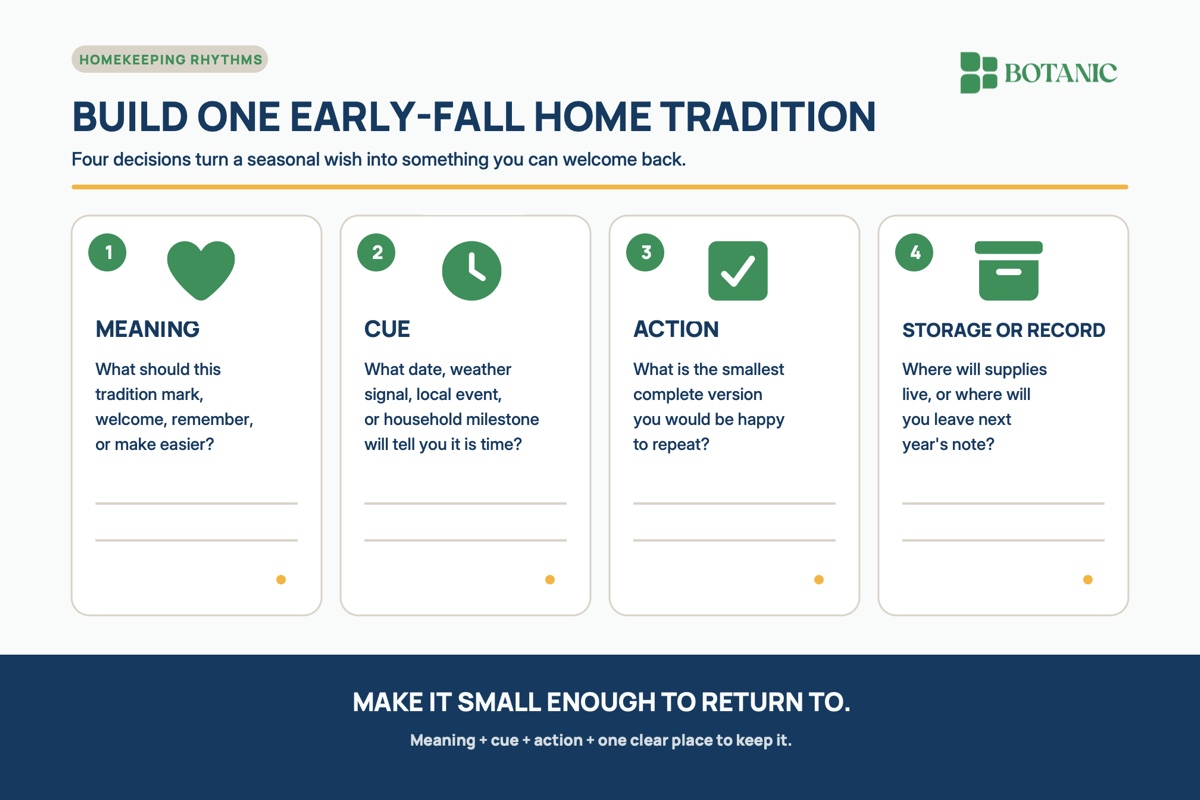
Use this four-field tradition builder
- Meaning: Write one sentence about what this tradition should mark, protect, welcome, remember, or make easier.
- Cue: Choose the date, weather signal, local event, or household milestone that will tell you it is time.
- Action: Define the smallest complete version, including who participates and where it begins and ends.
- Storage or record: Decide where the few supplies will live or where you will leave next year’s note.
Before you finish, read the four fields aloud. If the plan sounds expensive, crowded, or dependent on one perfect day, make it smaller. The strongest tradition is not the one with the fullest table or prettiest photograph. It is the one your household can recognize, carry out, and welcome back.
With care,
Hazel