
Five Books for Paying Better Attention to the Natural World
September 21, 2026
There is a difference between being outside and really noticing where you are. I love a book that helps close that distance. Not because every walk needs to become a lesson, but because a good question can make the familiar feel alive again. A bird call becomes something worth listening for. A tree becomes more than green shade. A roadside bloom becomes part of the story of the place you call home.
This is a seasonal Botanic Living curation, not a list of the books currently on my table. It is a small shelf for anyone who wants to meet the natural world with more curiosity and less hurry. You do not need all five at once. Choose the one that answers the question you keep carrying outside with you.
For seeing relationship: Braiding Sweetgrass
Robin Wall Kimmerer’s book belongs here because it turns attention into a practice of gratitude and care. It is less a field guide than a companion for anyone trying to notice what they receive from a place and what it means to respond with respect. It has been an important Botanic Living touchstone for the way it connects observation, stewardship, and the ordinary work of living well.
For putting a name to the birds: The Sibley Guide to Birds, Second Edition
David Allen Sibley’s guide is the kind of broad reference that earns a permanent place at home. Birds do not wait politely while we look them up, but the book gives you a way back into the moment later. The next time you notice shape, color, movement, or a familiar call, you have a better place to begin.
For roadside color: Texas Wildflowers
Campbell and Lynn Loughmiller’s guide is an inviting way to look more closely at the blooms that appear along a walk, a road, or the edge of an open field. Start with what you can see, then let the pages slow you down enough to notice leaves, stems, season, and setting. The point is not to get every answer immediately. It is to become a little more observant the next time you pass the same place.
For the long view of trees: Trees of Central Texas
Robert A. Vines’s book makes a good companion for anyone who wants to understand the steady structure underneath a Hill Country landscape. Trees ask a different kind of attention. Their bark, branching, leaf shape, and growing habit hold their own record of place. They are a reminder that some of the most important parts of a landscape are working quietly in plain sight.
For seeing the whole place: The Natural History of Texas
Brian R. Chapman and Eric G. Bolen bring the larger picture into view: water, geology, grasslands, wildlife, and the forces that shape a region over time. This is the book for the reader who keeps asking why the landscape looks the way it does. It can turn a familiar drive or a short walk into a fuller story about the ground beneath it.
One small way to begin
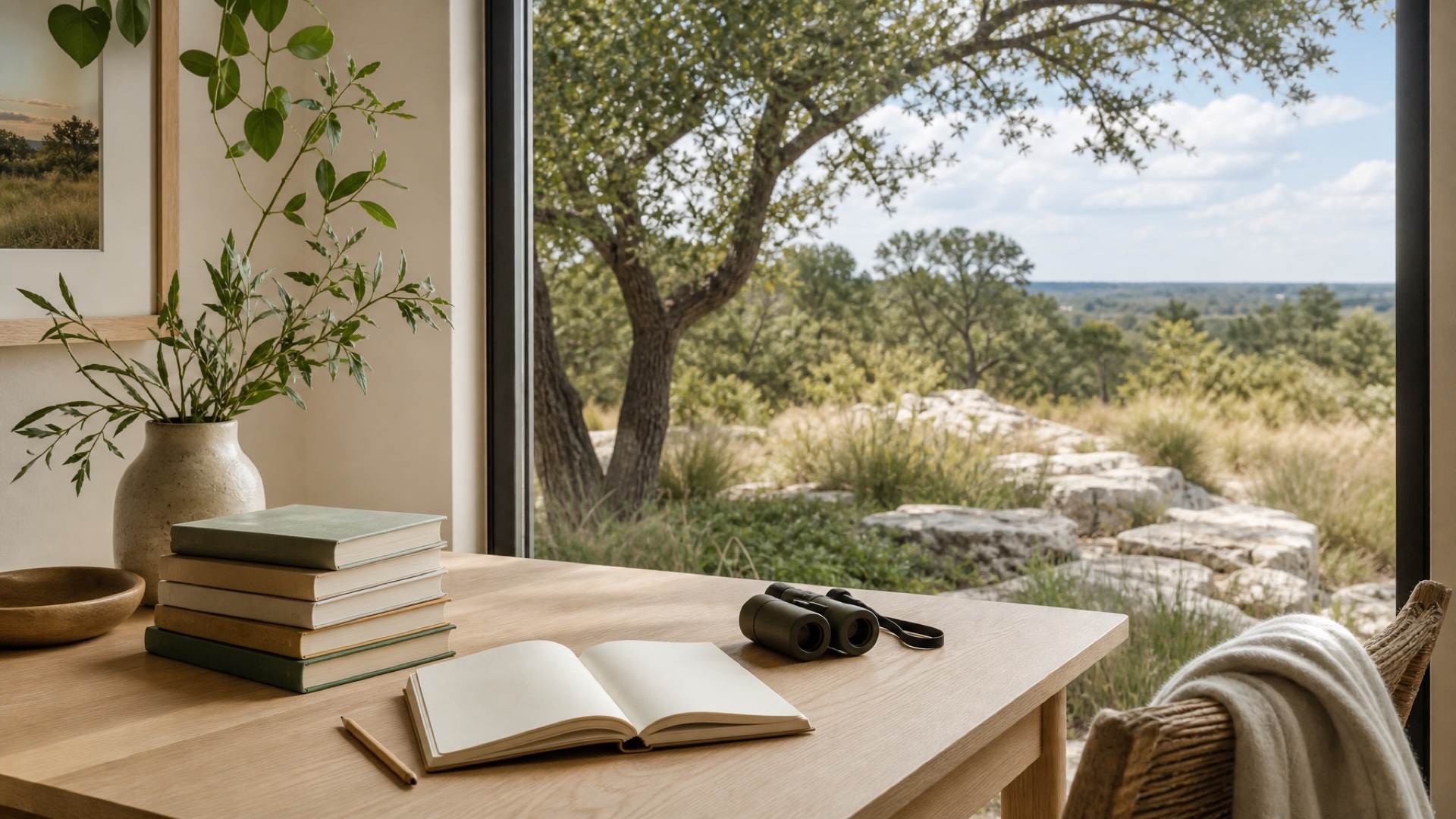
Take one book outside, even if it stays closed most of the time. Bring a notebook too. Write down the date, the weather, and one thing that held your attention. Maybe it is a bird moving through the oak shade, a flower at the edge of the road, or the particular texture of limestone under your feet. A small record becomes its own kind of relationship with a place.
We do not have to become experts to become more attentive. We only have to let the world around us be more interesting than our rush to get through it.
With love and intention,
Jennifer