
A Seasonal Filter and Vent Check for Late Summer
August 24, 2026
A filter can be faithfully maintained and still be hard to find six months later. It may live behind a return grille, inside a portable unit, under a range hood, or behind a cover you have never needed to open. The useful late-summer task is not to replace everything in sight. It is to locate each item, find the exact direction that governs it, make a safe check, and leave a record for the next person.
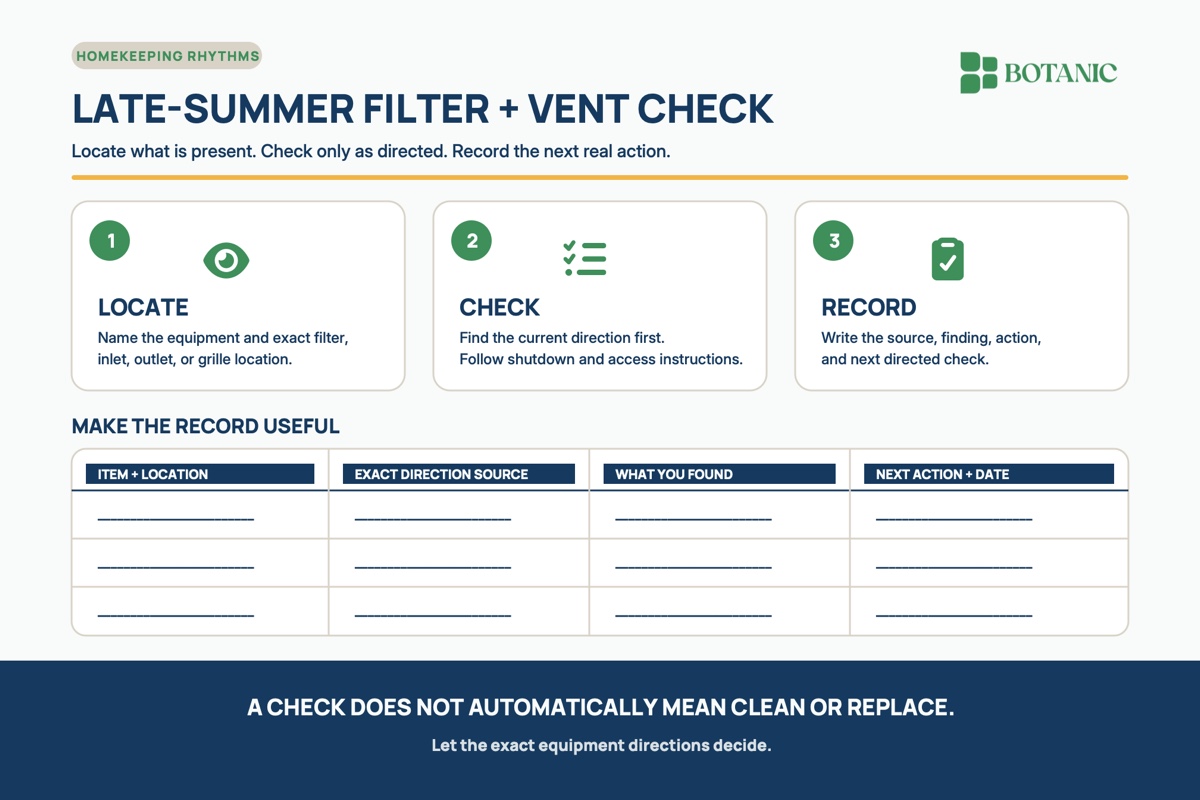
This is a focused walkthrough, not a whole-home reset or a generic maintenance calendar. Choose the filters and accessible vents you can identify without dismantling equipment. Let the exact manual, label, service agreement, and qualified guidance determine what inspection, cleaning, replacement, shutdown, access, part, and timing are appropriate.
Use late summer as a checkpoint, not a deadline
Seasonal cues are useful because they give a household a reason to look before the next weather pattern or heating season changes routines. ENERGY STAR uses spring and fall as memorable times for professional heating and cooling checkups. That does not make August 24 the correct service date for every system, filter, or climate.
Your late-summer check may produce several different answers. One filter may be ready for a manufacturer-directed replacement. Another may have a washable component with a specific care method. A third may need no action beyond recording its condition and the next directed check. Treat all three outcomes as successful maintenance.
If the household already has a service plan, rental maintenance process, building manager, or accessibility arrangement, begin there. The right result may be a message to the responsible person rather than opening the equipment yourself.
Make an equipment map before you remove anything
Walk through the home with a short record sheet. Look for the central heating and cooling filter location, portable air cleaner filters, room air-conditioner filters, and filters or accessible grilles on appliances such as a range hood, dehumidifier, vacuum, or exhaust fan. Include only equipment that is actually present and identifiable in your home.
Write the item name, room, maker, and model when available. Then record the filter or grille location in practical language, such as “hall return grille” or “rear panel of bedroom air cleaner.” If one system has more than one filter location, list each location separately instead of trusting a single note to cover all of them.
Do not remove an unfamiliar cover simply to complete the map. A label, model record, service invoice, building document, or qualified technician can help identify what is user-accessible. Unknown equipment is a question to resolve, not an invitation to experiment.
Let the exact directions define the check
Find the current manual or official directions before touching the filter. Record whether the maker describes it as disposable, washable, cleanable by a particular method, service-only, or part of a larger maintenance procedure. Also note any required shutdown, unplugging, cooling period, panel release, orientation, fit, drying, reset, or replacement-part direction.
The U.S. Environmental Protection Agency advises replacing furnace and HVAC filters according to the manufacturer’s recommendations. It also notes that a filter should fit snugly without being bent or crushed. Those principles are more useful than choosing a replacement by appearance alone. Do not rinse a disposable filter, vacuum a filter that is not approved for that method, install a more restrictive filter, or substitute a similar-looking part without confirmation.
When the directions permit a user check, observe the condition fields the source actually makes relevant. These may include visible loading, damage, fit, orientation, a filter alert, or a recorded run-time or calendar interval. A dark color by itself does not identify every captured material, prove a health problem, or tell you which replacement belongs in the equipment.
Treat a vent check as an observation, not a duct-cleaning job
For an accessible supply grille, return grille, equipment inlet, outlet, or exhaust cover, first look for anything blocking the normal airflow around the outside. Furniture, curtains, stored objects, paper, and household clutter can obstruct some equipment. The EPA specifically advises keeping portable air cleaners away from curtains and other objects that might block airflow.
Clean only the accessible exterior surface and only with a method the exact material and equipment directions permit. Do not push a tool into an opening, remove a fixed grille, enter ductwork, spray liquid into equipment, open an electrical or combustion compartment, or climb for a vent that cannot be reached safely. A seasonal visual check is not a substitute for duct, dryer-exhaust, combustion, electrical, refrigeration, roof, or professional HVAC service.
Stop and route the problem appropriately if you see a loose or damaged cover, visible moisture, staining that is new or unexplained, debris blowing from an opening, a crushed filter, repeated filter displacement, a persistent equipment alert, unusual odor, unusual heat, damaged wiring, or a change in equipment operation. The record should describe what you observed without diagnosing the cause.
Record what you found, including no action
For each item, write the date, exact direction source, what you observed, what action was completed, the precise replacement part or cleaning method when applicable, and the next check set by that source. If the correct outcome is “no action today,” record that too. It prevents a later check from turning into guesswork.
Keep the record beside the household maintenance system or link it to the equipment’s existing item record. A photograph of a model plate or filter orientation may help if the maker permits it and no sensitive information is exposed. Do not rely on a photograph in place of the current manual, and do not post serial numbers, service-account details, or access information publicly.
When the next date depends on use, an indicator, visible condition, or professional service rather than a fixed interval, copy that condition accurately. A useful reminder can name the filter alert or next scheduled service as its cue instead of inventing a calendar date.
Use this five-step late-summer pass
- Choose the boundary. Include only identifiable filters and accessible vents that can be checked without unsafe height, dismantling, or restricted service work.
- Locate and name each item. Record the equipment, room, model, and exact filter, inlet, outlet, or grille location.
- Find the controlling source. Read the current manual, label, service agreement, building direction, or qualified guidance before removal or cleaning.
- Check only as directed. Follow every shutdown and access instruction, observe the relevant condition, and stop for damage, moisture, unusual operation, or uncertain scope.
- Leave one clear record. Write what you found, what was done, the exact part or method when relevant, and the next directed check or responsible person.
A seasonal rhythm earns its place when it makes the next real task easier. Finish with a map that another person could follow and a short list of actions that actually belong to your home. Then close the covers you were directed to open, put the manuals back where they can be found, and let the record carry the work into the next season.
Power off before an accessible inspection
Before removing an accessible filter, grille, or cover, follow the appliance or system instructions and use the specified shutoff procedure. Do not reach into equipment, remove sealed panels, or turn a vent check into an improvised repair.
Record the filter size, direction, date, and any visible condition you can safely confirm. A clogged filter, damaged grille, unusual noise, persistent odor, or poor airflow may call for the manufacturer, a qualified technician, or building management rather than more household cleaning.
With care,
Hazel