Why Your Entryway Mat Stops Working in October
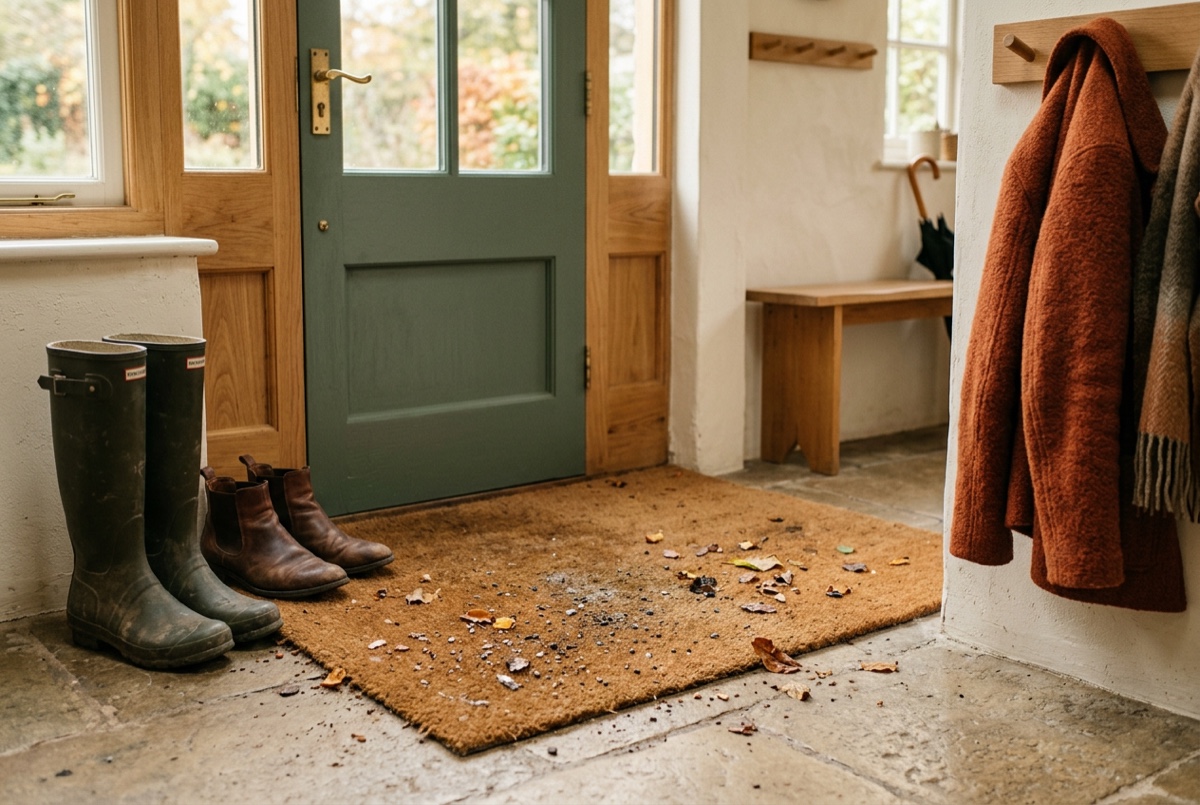
October is when a mat can appear to fail overnight. Leaves, damp grit, and heavier shoes arrive at the door, and suddenly the floor beyond the mat is carrying the evidence.
A mat needs enough distance
A tiny mat gives shoes only a step or two to release dirt. If the door opens directly onto the living space, the mat may be doing all it can simply because it has not been given enough runway.
Wet is different from dusty
A saturated mat cannot keep receiving moisture effectively. Shake or clean it according to its care instructions, then let it dry fully. A damp mat that never dries is not a better mat.
Placement matters
Keep the mat where feet actually land, not where it looks best in a photograph. If a tray, shoe bench, or wall hook forces people to step around it, the system is working against the textile.
The goal is not a perfect threshold. It is a mat that has a fair chance to do its job.
Give the threshold a two-part system when the weather turns: one mat outside to catch coarse grit and another just inside to catch what shoes carry through. The outside piece needs a surface suited to weather, while the inside piece should be easy to shake, vacuum, or wash. If the mat is staying wet, the answer may be a second mat for rotation rather than a stronger cleaner.
If the floor is still dirty after the mat is cleaned and correctly placed, look at the route people actually take. A second mat, a shoe-removal cue, or a tray for wet footwear may solve more than repeated vacuuming. Avoid saturating a natural-fiber mat or using a cleaner the care label does not allow. The threshold needs a system that fits the way the household enters, not an idealized doorway.
With care,
Hazel