A Starter Shelf for Texas Birds, Wildflowers, and Hill Country Life
August 17, 2026
I did not start out knowing the names of the birds and wildflowers around my own property. I started out curious. The more I paid attention, the more I wanted to know what I was looking at. A field guide did not make the landscape less mysterious. It gave me a better way to pay attention.
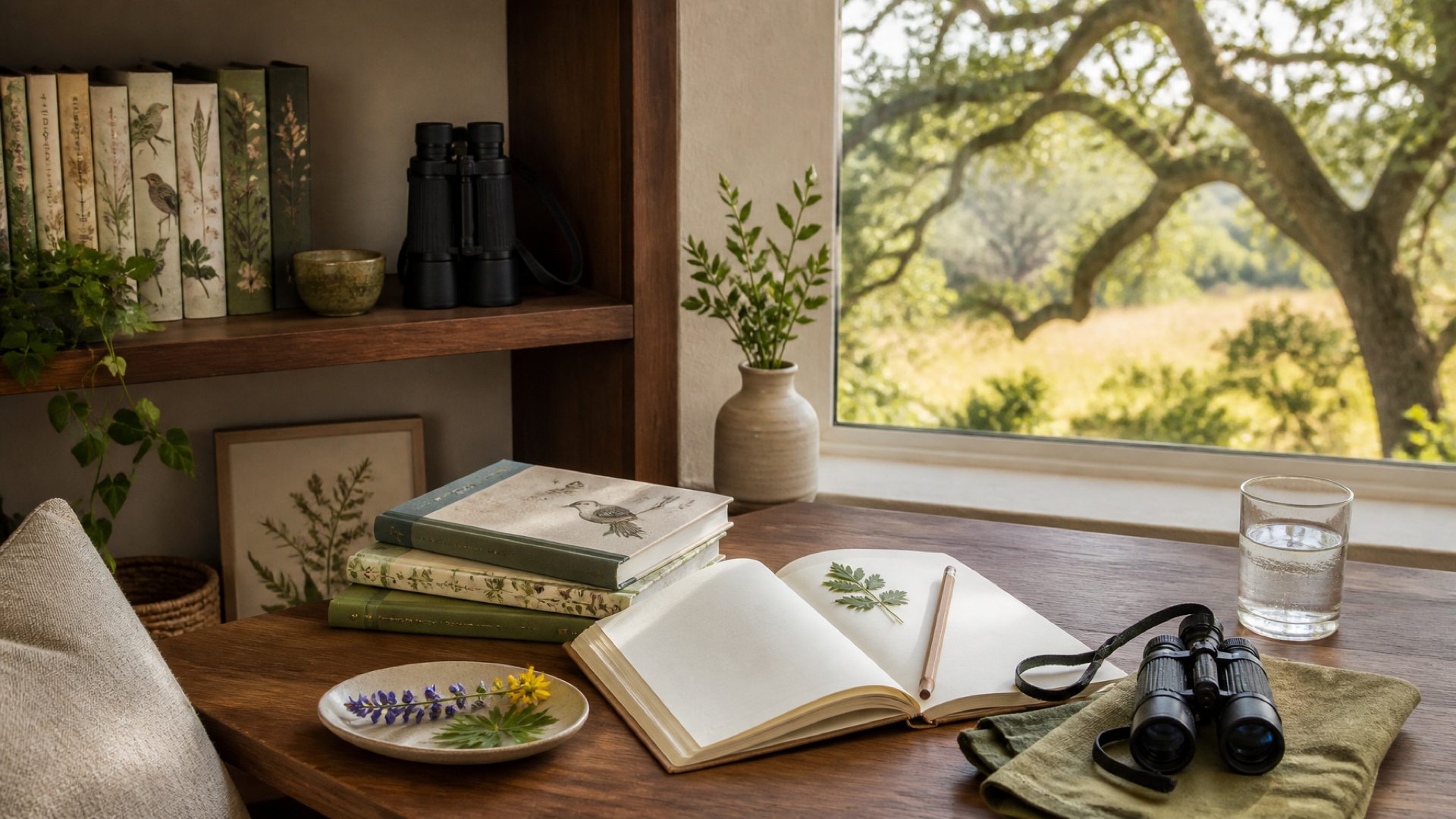
This is the starter shelf I would hand to a friend who wants the same thing: a few dependable guides, one good pair of binoculars, and a blank notebook. You do not need a large library to begin. You need tools that earn their place and the habit of taking them outside.
Birds: two guides and one good pair of binoculars
The Sibley Guide to Birds, now in its second edition, is the broad reference I keep at home. It covers the whole continent, which sounds like too much until you need to sort out a confusing warbler or a distant hawk. Sibley’s illustrations account for age, sex, season, and viewing angle, which is where most bird identification actually goes wrong.
For carrying outdoors, Stan Tekiela’s Birds of Texas Field Guide, second edition, narrows the options to the birds you are most likely to see here. That matters on a walk. When a bird moves quickly, you want the shortest path from “what is that?” to a name.
Guides only help if you can actually see the bird. The binoculars I use and recommend are the Vortex Crossfire HD 12×50. The glass is clear, the focus is smooth, and they are waterproof and fogproof, which matters in Texas humidity. The 12x magnification brings distant birds close enough to study, the included harness keeps them on your chest instead of swinging from your neck, and they are tripod adaptable when you want to hold steady on a small bird at the edge of the tree line.
Wildflowers: a color-first guide for the Hill Country
Campbell and Lynn Loughmiller’s Texas Wildflowers is the approachable photographic reference I reach for most. It is arranged by color and family, so you can flip straight to the section that matches what is blooming in front of you. Look for bloom time and range as well as the photograph, and remember that flower color alone is rarely enough to separate similar plants. Leaves, stems, and habitat matter too.
One honest note: not every roadside bloom is native. Some of the brightest flowers you will see along Texas highways were introduced. That does not make them less lovely, but a good guide helps you tell the difference between a native and a visitor.
Trees and woody plants: the bones of the landscape
Robert A. Vines’s Trees of Central Texas is the classic reference for the live oaks, cedar, and creek-bank growth that shape the Hill Country. Trees change slowly, which makes them excellent teachers. Learn to read leaf shape, bark, fruit, thorns, and growing habit, and you can identify a tree in winter when there is not a flower or leaf in sight.
Hill Country as a system: one book that ties it together
Identification tells you what something is. Ecology and history begin to explain why it is here. Brian R. Chapman and Eric G. Bolen’s The Natural History of Texas is the book I recommend for that larger view. It covers geology, water, grasslands, and wildlife, and it helps the landscape make sense as a working system: limestone, springs, droughts, fire, grazing, and the plants and animals that belong to each setting.
A notebook of your own
The final item on the shelf is a notebook, and it should start blank. Write down the date, the weather, the place, the species, and one thing you noticed. It does not have to be elegant. A modest list made consistently becomes a personal field guide that no store can sell you.
Begin with the library and borrow widely. The books you keep should be the ones that keep sending you back outside with better questions.
With love and intention,
Jennifer
This post contains affiliate links. If you purchase through a link, I may earn a small commission at no extra cost to you. I only recommend the binoculars I use and trust myself.