November 20, 2026
A bench scraper looks like a tool for people who make bread every weekend. It is actually one of the most useful small objects in a busy kitchen. The flat blade gathers, lifts, divides, and clears without asking you to reach for a knife, your fingernails, or a damp handful of food.
It is a second set of hands for the counter
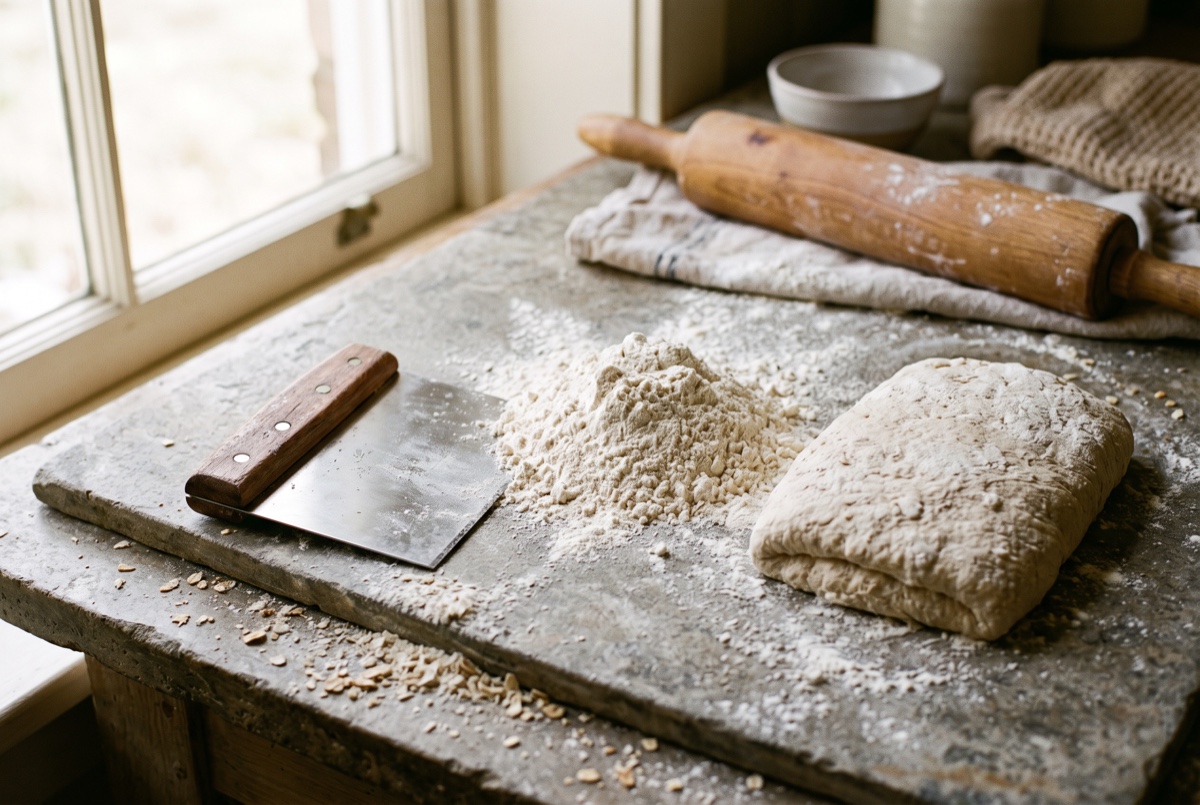
The broad, rigid edge slides under dough that has stuck to a work surface. It can portion a mass of dough into more even pieces without dragging a knife through the counter. It can also gather chopped onions, herbs, or vegetables into a bowl. Use the broad face as a scoop, keeping the sharp edge of the scraper against the board rather than scraping with a knife blade.
This is especially useful when the counter is busy. The scraper gives loose ingredients a clear route from board to pan and helps prevent small pieces from being brushed onto the floor.
It cleans the work surface without a chemical performance
After cooking, a bench scraper can lift dried flour, pastry scraps, sticky dough, and small piles of food from a counter or wood board. Remove the debris first. Then clean the surface with the material-appropriate method. A scraper removes material. It does not sanitize a surface, and it does not replace washing.
Use a light angle and modest pressure. On a wooden board, follow the grain when possible and avoid gouging. On stone or a coated surface, confirm that the tool is suitable before using it. A metal scraper can scratch some finishes. A plastic version is a gentler choice for uncertain surfaces.
Know what it is not for
A bench scraper is not a pry bar, a can opener, or a substitute for a cutting board. Do not use it to open packages, scrape a hot oven surface, or force material from a delicate finish. Keep fingers behind the broad top edge and store the tool where the blade cannot catch a hand reaching into the drawer.
Some scrapers have a sharp enough edge to cut dough cleanly. That does not make them kitchen knives. If children help in the kitchen, choose a blunt plastic scraper and set clear limits for where it is used.
Why it earns the space
Good kitchen tools solve several ordinary problems without creating a new one. A bench scraper reduces the number of dirty utensils, keeps hands cleaner during prep, and makes the counter easier to clear between tasks. It is useful before cooking, during cooking, and at cleanup. That is a rare amount of work from a flat rectangle.
- Use it to divide sticky dough.
- Move chopped ingredients from board to bowl.
- Lift flour and dried scraps from the counter.
- Gather vegetable trimmings before wiping the surface.
- Cut soft dough into portions without dragging a knife.
Wash the scraper after use, including the seam where a handle joins the blade. Dry it fully before putting it away. If it has a wooden handle, follow the maker’s care instructions and do not leave it soaking.
Choose the simplest version that fits your kitchen
You do not need a decorative set. Look for a comfortable grip, a flat edge that matches your usual work surface, and a size that fits the drawer. Stainless steel is durable but may be too aggressive for some finishes. Plastic is lighter and often more forgiving. A ruler edge can help with dough portions, but it is not essential.
The best tool is the one that comes to hand before a mess spreads. A bench scraper has earned its drawer space when it makes the next small job easier, which is exactly what a kitchen tool should do.
With care,
Hazel