Why Humidity Changes How a Home Feels and Dries
August 27, 2026
Some days, a hand towel feels dry before lunch. On another day, the same towel is still cool and damp late in the afternoon. A freshly wiped counter may stay wet longer, a bath mat may need more space, and air-dried laundry may seem to pause halfway to dry. The amount of water on those materials matters, but so do the air temperature, surrounding moisture, and air movement.
Humidity helps explain the pattern. It does not identify every cause by itself, and one number does not tell you whether a room has a leak, inadequate exhaust, a cold surface, or simply a short-lived moisture load from showering, cooking, or drying laundry. The useful approach is to understand what relative humidity means, then pair a reading with what is happening in the room.
Relative humidity is a relationship
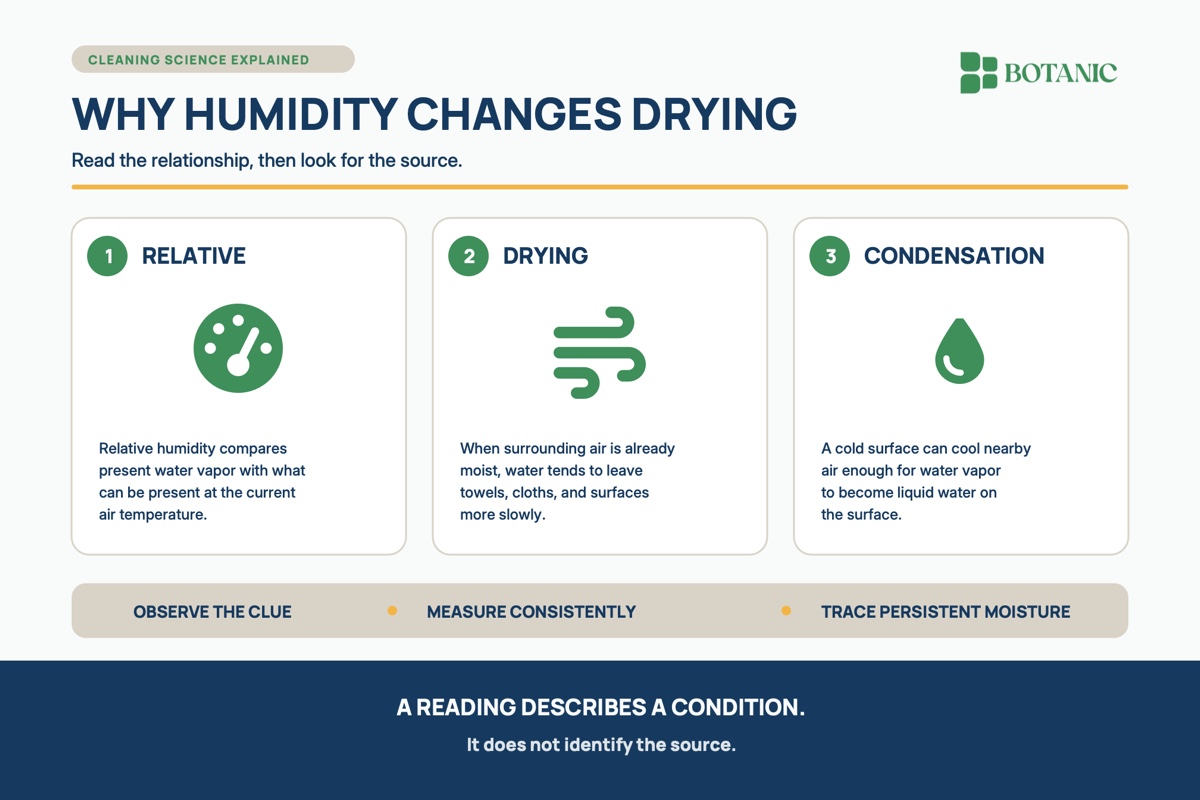
Relative humidity compares the water vapor currently in the air with the amount that could be present at that air temperature. That temperature detail matters. The National Weather Service explains that the same amount of water vapor produces a higher relative humidity when the air is cooler and a lower relative humidity when the air is warmer.
This is why a single percentage needs context. A reading can change as the room temperature changes even when the actual amount of water vapor has not changed in the same proportion. Record the temperature with the relative humidity, and compare readings from the same location under similar conditions.
Drying depends on evaporation
Drying happens when liquid water becomes water vapor and leaves a surface or textile. The U.S. Geological Survey describes evaporation as the change from liquid water to gaseous water vapor and notes that the process requires energy. In ordinary homekeeping, drying is also affected by how easily that vapor can move away from the damp material.
When the surrounding air is already moist, evaporation tends to proceed more slowly than it does in drier air under otherwise similar conditions. Limited air movement can slow the process further because the moist air immediately around the item is not being replaced as readily. A thick towel, layered bath mat, crowded drying rack, or folded cleaning cloth also holds water in places that have less exposed surface area.
That does not mean every slow-drying item needs a different wash product or a hotter setting. First check the care label, the directed drying method, the load or rack spacing, and whether air can reach the wet areas. Only fold or store household textiles when they are fully dry.
Condensation is a surface clue
Condensation is the reverse change: water vapor becomes liquid water. The USGS explains that this can happen when saturated air is cooled, as it is beside a cold glass. At home, a cool window, pipe, wall area, or other surface can cool nearby air enough for liquid water to collect.
Do not treat every wet surface as ordinary humidity. A recurring patch, active drip, staining, softened material, damaged finish, or water appearing away from an expected cold surface may point to a plumbing, roofing, drainage, insulation, or building-envelope problem. Dry the visible moisture, protect the surrounding material, and trace the water source rather than repeatedly wiping the symptom.
Read the room as a group of clues
Start with what changed. Did several items begin drying slowly at the same time? Did the pattern start after a shower, cooking session, open-window period, appliance use, weather change, or HVAC change? Is moisture limited to one cold surface, or does it appear in several places? Does an exhaust fan actually move air, and is an appliance that produces moisture vented as its manufacturer directs?
The U.S. Environmental Protection Agency recommends responding quickly to condensation or moisture on windows, walls, and pipes, and reducing the moisture source. Its household guidance says that, if possible, indoor relative humidity should remain below 60 percent and ideally between 30 and 50 percent. That is a general moisture-control reference, not a substitute for the instructions for your climate, building, HVAC equipment, humidifier, dehumidifier, museum-quality object, instrument, or material-sensitive collection.
Use a meter to find a pattern, not a diagnosis
A small humidity meter can help answer a bounded question such as, “Does this bathroom reading rise after a shower and return toward its usual range after the directed exhaust period?” Place the meter according to its instructions, away from splashing, direct steam, a supply register, an open window, or direct sunlight unless that exact location is what you are investigating.
Record the room, date, time, temperature, relative humidity, recent moisture-producing activity, visible condensation, and drying clue. Repeat under similar conditions for several observations. If the reading stays elevated, condensation persists, materials remain wet, or you see water damage, use the record when you contact the property manager, equipment manufacturer, or an appropriate building professional. Do not open walls, dismantle equipment, or guess at a repair from the percentage alone.
A five-step humidity and drying check
- Name the clue: Record exactly what is slow to dry, where condensation appears, or which material feels damp.
- Note the conditions: Record the room temperature, recent showering, cooking, laundry, weather, open windows, exhaust, or equipment change.
- Measure consistently: Use the same meter, location, height, and observation time when you want to compare readings.
- Support drying correctly: Follow the care label or surface directions, expose wet areas, create permitted spacing, and use ventilation or equipment only as directed.
- Trace persistent moisture: Escalate recurring condensation, leaks, damage, or material that will not dry instead of treating a humidity number as the full explanation.
Humidity is most useful when it helps you notice a relationship: the room conditions changed, drying changed, and a visible clue appeared or disappeared. Keep the observation specific, compare like with like, and let persistent water lead you toward the source rather than another round of wiping.
Treat the source, not only the symptom
If a window, wall, textile, or room repeatedly stays damp, wiping the visible moisture is only the first step. Look for the source and the conditions that keep adding water: a leak, condensation, poor airflow, slow-drying laundry, or an appliance problem.
Ventilation, heating, cooling, and dehumidification can change a room, but the right response depends on the building and the source. Persistent dampness, visible growth, water damage, or a health concern is a maintenance or professional-assessment question, not a reason to keep adding fragrance or cleaner.
With care,
Hazel