Hazel’s Homekeeping Guide
August 9, 2026
A clean cloth can look exactly like the one you just used around the toilet, on the floor, or beneath the trash bin. When every cloth lives in one stack and every used cloth lands in one heap, it is easy to lose track. The solution is not necessarily a rainbow set or a complicated household rule. It is a clear job assignment that you can recognize even when you are moving quickly.
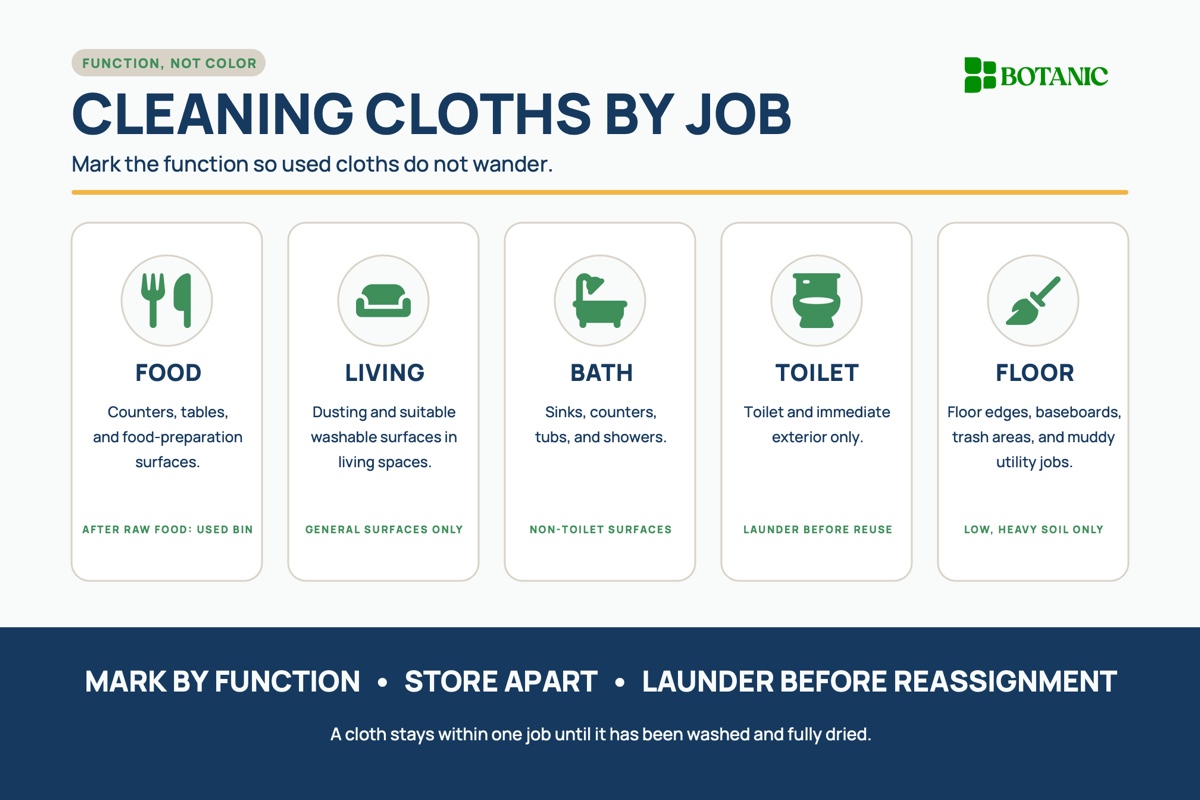
Think of the system as a boundary around each cloth’s work. A cloth may clean several compatible surfaces within one job, but it does not wander into a different job before it has been laundered and fully dried.
Begin with five practical jobs
You can adjust the number of groups to fit your home, but these five cover the places where accidental cross-use is most likely:
- Food preparation and dining: Use these cloths only on kitchen counters, tables, and other surfaces connected with preparing or serving food. If a cloth contacts raw meat, poultry, seafood, eggs, or their juices, stop using it for the cleaning round and move it directly to the used-cloth container.
- General living spaces: Reserve these for dusting and cleaning suitable washable surfaces in bedrooms, living rooms, halls, and home offices.
- Bathroom surfaces: Use these for sinks, counters, tubs, showers, and other non-toilet bathroom surfaces, following the material and product directions for each one.
- Toilet only: Give the toilet and its immediate exterior a clearly marked cloth that never moves to another task before laundering.
- Floors and utility jobs: Keep a separate group for baseboards, floor edges, trash areas, muddy entry points, and other low or heavily soiled work.
A small home may need only one or two cloths in each group. A busy household may need enough clean cloths to finish a room without rinsing and reusing the same saturated one. The assignment matters more than the size of the stack.
Mark the job, not just the color
Color can be useful, but color alone is easy to forget and may not work for every household member. Add a function cue that makes sense without a memorized key. You might stitch a short loop into one corner, add a washable tag, use different edge patterns, or store each group in a plainly labeled bin. A tactile marker can help when color is not a reliable cue.
Keep the words direct: FOOD, LIVING, BATH, TOILET, and FLOOR. If writing on the cloth is impractical, put those same words on the clean-storage compartments. The goal is recognition, not decoration.
Use one job from cleaner areas toward dirtier ones
Within a single assigned job, begin with the cleaner-looking surfaces and finish with the dirtier ones. Fold the cloth into quarters so you can expose a fresh section as soil builds. Move the cloth to the used-cloth container when it is visibly soiled, saturated, has touched a material you do not want carried farther, or can no longer pick up residue cleanly.
Do not dip a used cloth back into a shared bucket or container of cleaning solution unless the product and method specifically direct it. Pouring or spraying the required amount onto the cloth or surface, when the label and material allow, can help keep the remaining solution from receiving soil from the cloth.
Give used cloths one landing place
Set up a washable, ventilated container for used cleaning cloths. It should be easy to reach during a cleaning round but separate from clean cloth storage, kitchen towels, bath linens, clothing, and food. Do not seal damp cloths in an airtight container for extended storage. If they cannot be laundered promptly, spread or hang them in a suitable protected place to dry first, away from food preparation and out of reach of children and pets.
A toilet cloth or a cloth used on raw-food juices should not wait on a counter while the rest of the room is cleaned. Move it directly to the used-cloth landing place, wash your hands, and continue with a fresh cloth if the job is not finished.
Launder according to the cloth and the soil
Read the cloth manufacturer’s care instructions before choosing water temperature, detergent, bleach, drying method, or additives. Microfiber, cotton, and blended cloths can have different care needs. The American Cleaning Institute advises sorting heavily soiled items away from lightly soiled laundry because soil can transfer in the wash. FoodSafety.gov specifically advises washing dishcloths often in the washing machine’s hot cycle, but the cloth’s care label and your machine instructions still control what the textile can tolerate.
Keep cleaning textiles separate from clothing or household linens when their soil, product residue, or care requirements do not belong in the same load. Use the detergent amount and washer setting directed for the load. Dry every cloth completely before returning it to clean storage, then put it back with its assigned job rather than in a general stack.
Cleaning, sanitizing, and disinfecting remain separate decisions
A cloth assignment system does not sanitize or disinfect anything by itself. The CDC distinguishes routine cleaning from sanitizing and disinfecting, and notes that regular cleaning is enough in many home situations. When sanitizing or disinfecting is needed, clean first and use an appropriate product exactly as its label directs.
The product label controls surface suitability, application, protective equipment, ventilation, contact time, rinsing, and storage. It also controls whether a reusable cloth belongs in the method. Never mix cleaning or disinfecting products. After using a cloth with a specialized product, follow both the product directions and the cloth manufacturer’s laundering guidance.
A simple rule that keeps the system working
Before a cloth leaves clean storage, you should be able to answer one question: What job does this cloth belong to? After the job, it has only two destinations, the used-cloth container or the wash. That small boundary makes the system easier to remember than a long list of exceptions.
Start with the two assignments that matter most in your home, perhaps FOOD and TOILET, and add the others only when they solve a real mix-up. A good cloth system should make cleaning feel clearer, not give you another complicated routine to maintain.
Warmly,
Hazel
With care,
Hazel