Household Cues That Keep You From Re-Deciding the Same Task
August 10, 2026
Some household tasks are tiring before the work even begins because they arrive with a small decision. Where should this go? What happens next? Which tool do I need? Did I already do the first step?
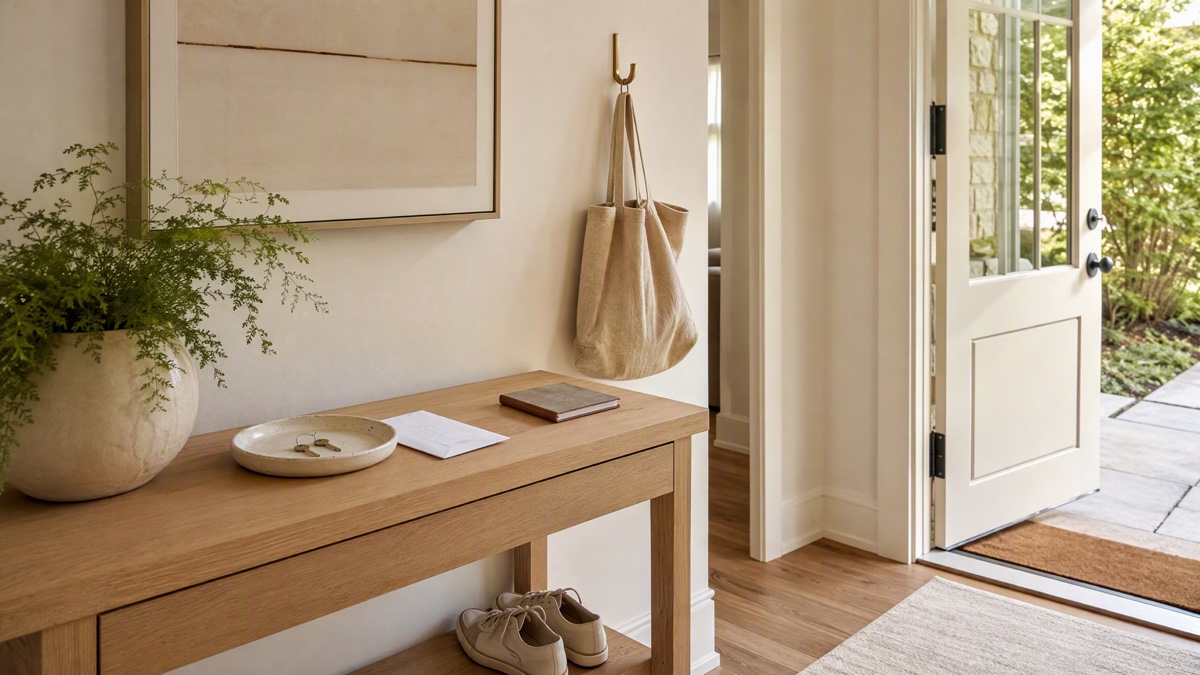
A household cue answers one of those questions in advance. It might be a tray where keys always land, a basket labeled for the action its contents need, a watering can kept near the plants, or a short sequence card beside the washing machine. The cue does not complete the task for you. It makes the next useful action easier to recognize.
Researchers use the term prospective memory for remembering to carry out a planned action later. Research on intention offloading also examines how people use calendars, reminders, strategically placed objects, and other external tools instead of relying only on memory. A home can use that same practical principle without turning every room into a command center.
Begin with one recurring pause
Do not label the whole house at once. Notice one place where the same hesitation happens repeatedly. Perhaps library books disappear into a general pile, clean laundry waits because no one knows which room it belongs in, or plant care depends on remembering where the watering can was last used.
Name the decision as plainly as possible. “Where do outgoing items wait?” is more useful than “The entryway is always messy.” “What is the first step after the washer finishes?” is more useful than “Laundry takes forever.” A specific pause gives you something small enough to redesign.
1. Create a visible landing place
A landing place is a defined spot for something that arrives, leaves, or pauses between steps. It may be a shallow tray for keys, a hook for a reusable shopping bag, a shelf for library books, or a divided basket for papers that need attention.
Choose the location by following the object’s real path through the home. Put the cue where the decision naturally occurs, not where an idealized organizing plan says it should occur. Keep the boundary clear enough that the landing place does not quietly become storage for every unrelated object.
2. Label the action, not only the category
A category label tells you what an item is. An action label tells you what should happen next. “Paper” may still leave you deciding. “File,” “reply,” or “recycle” gives the contents a direction. “Clothes” is broad. “Return upstairs” or “mend” identifies the next step.
Use ordinary words that everyone in the household understands. When color is part of the system, pair it with text, a simple symbol, a tactile marker, or a consistent compartment so the cue does not depend on color alone. Keep labels large enough to read from the place where the decision is made.
3. Put the first tool at the point of use
Sometimes the best cue is the first tool a task requires. A watering can beside the indoor plants, a pencil clipped to the freezer inventory, or a lint brush near the coat closet can make the next action obvious. Store the tool where the task begins when that location is practical and safe.
Point-of-use placement does not override safe storage. Cleaners, medicines, matches, batteries, blades, and other hazardous items still belong in the secure location required by their labels and household circumstances. Do not block a walkway, doorway, handrail, switch, vent, or accessibility aid in order to make a cue more visible.
4. Write a short sequence card
A recurring task can stall when its first step is hidden inside a long mental list. Write the smallest complete sequence that gets the task moving. A laundry card might say: check pockets, read care labels, sort, choose the permitted cycle, and start. A plant-care card might say: check the soil, water only as the plant requires, empty the saucer when needed, and return the can.
Place the card where the sequence begins. Three to five steps are usually easier to scan than a full instruction page. If the task involves a product, appliance, textile, or household surface, the card should point back to the complete label or manufacturer instructions rather than replacing them.
Match the cue to a real moment
A cue works best when it answers both parts of the reminder: when should I notice this, and what should I do next? “After I bring in the mail, I place anything that needs a reply in the reply tray” is more specific than “deal with mail.” “When I unload the last grocery bag, I put the reusable bags on the door hook” connects a visible object, a real moment, and one action.
This does not mean every task will become automatic or effortless. A cue can be missed, buried, moved, or attached to the wrong moment. It may also stop helping when a household’s schedule, mobility, responsibilities, or season changes. Treat the setup as a practical test rather than a rule.
Test one cue for a week
- Choose one recurring household decision that causes a noticeable pause.
- Select one cue type: a landing place, action label, point-of-use tool, or short sequence card.
- Put the cue where the decision actually happens, while preserving safe storage and clear access.
- Use it for several ordinary days and notice whether the next action becomes clearer.
- Move, simplify, relabel, or remove the cue if it creates clutter or still leaves the decision unanswered.
The useful goal is not to make your home explain everything. It is to let one small part of the room hold a decision you should not have to make from scratch every day. Choose the pause you encounter most often, and give it one clear next step.
With care,
Hazel