What Laundry Symbols Actually Mean
August 12, 2026
A care label can look like a row of tiny geometry until one sweater, blouse, or pair of trousers depends on you reading it correctly. The easiest way to make sense of the row is not to memorize every possible symbol. Start with the five base shapes, then notice the marks inside or underneath them.
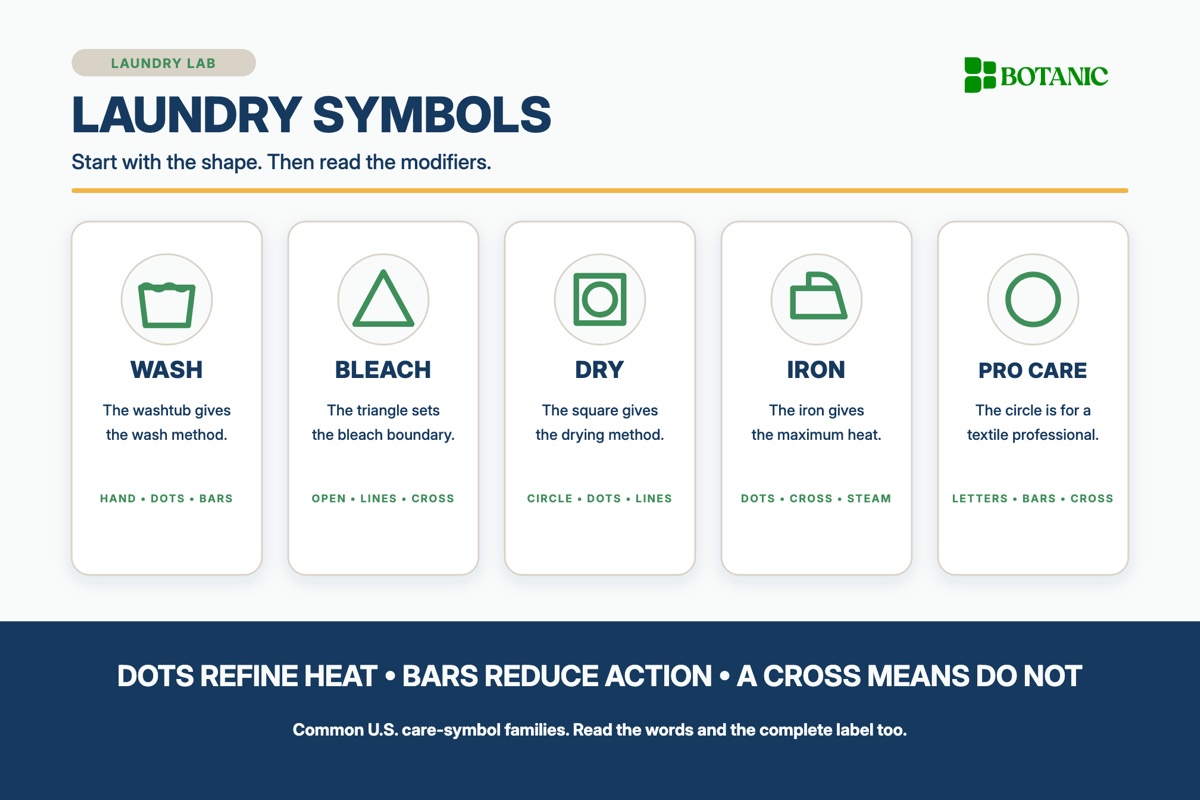
In the common United States system, a washtub addresses washing, a triangle addresses bleach, a square addresses drying, an iron addresses ironing, and a circle addresses professional textile care. Dots usually refine temperature, bars call for gentler mechanical action, and a large cross means not to use that process. Read every symbol and any written warning before you start, because the full sequence is the care plan.
First, know what the label is telling you
A care label describes a regular care method the manufacturer has a reasonable basis to recommend for the finished item. That distinction matters. Fiber content alone does not tell you how to treat a garment that also has dye, lining, interfacing, elastic, buttons, printing, or decorative trim. The instructions account for the item as a whole.
The label also sets a limit, not a challenge. A gentler process may be reasonable, but a hotter wash, stronger action, or higher iron setting can exceed the stated care. When words appear beside the symbols, read both. If the wording and your interpretation of a symbol seem to conflict, stop and consult the maker rather than choosing the harsher option.
The washtub tells you how to wash
A plain washtub means machine washing is permitted. In the common U.S. symbol set, one dot indicates cold water, two dots indicate warm water, and three dots indicate hot water. A hand reaching into the tub means hand wash. A crossed-out tub means do not wash.
Bars under the tub change the machine action. One bar indicates a permanent-press cycle, while two bars indicate a delicate or gentle cycle. No bar indicates normal action. These marks do not tell you how much detergent to use or whether the item should share a load with dark, lint-producing, or heavily soiled pieces. Follow the detergent and machine directions, then use written warnings such as “wash separately” or “wash with like colors” to finish the decision.
The triangle sets the bleach boundary
An open triangle means bleach is permitted when needed. A triangle filled with two diagonal lines means use only non-chlorine bleach when needed. A crossed-out triangle means do not bleach.
This category deserves a careful pause because “non-chlorine” does not mean that every product is suitable for every textile. Check the garment label and the bleach product label together. Use only a compatible product, measure it as directed, and never mix bleach with ammonia, acids, or another household cleaner.
The square tells you how to dry
A square is the drying family. A circle inside the square means tumble drying. In the common U.S. set, one dot means low heat, two dots mean medium heat, and three dots mean high heat. A crossed-out circle-in-square means do not tumble dry. Bars beneath the tumble-dry symbol call for reduced mechanical action, just as they do under the washtub.
Lines inside a plain square describe drying away from the machine. A vertical line means line dry, three vertical lines mean drip dry, one horizontal line means dry flat, and diagonal lines in an upper corner mean dry in the shade. Combinations can appear, so a symbol may direct you to drip dry in the shade or dry flat in the shade. Support a wet item as needed so its own weight does not distort it.
The iron gives the maximum heat
An iron symbol permits ironing. One dot means low heat, two dots mean medium heat, and three dots mean high heat in the common U.S. system. A crossed-out iron means do not iron. A separate no-steam mark can appear when dry heat is permitted but steam is not.
Set the iron for the most sensitive part of the garment, not merely the dominant fiber. Let the iron stabilize at the chosen setting, work from the wrong side when the maker directs it, and keep the soleplate away from prints, coatings, elastic, and trim unless their care information clearly permits contact.
The circle belongs to professional care
A circle points to professional textile care. Letters and bars inside or beneath it give a cleaner technical limits for solvent, moisture, heat, and mechanical action. A crossed-out circle means do not dry clean.
You do not need to translate every professional code at home. Show the complete label to the cleaner, mention stains and any home treatment already attempted, and leave the process choice to the professional. “Dry clean only” is also a warning not to wash the item. It is not an invitation to imitate a commercial process with a household solvent.
Read the whole row before sorting the item
Begin at the first symbol and move across the full label. A washable blouse might still prohibit bleach, require low tumble heat, and limit ironing. A sweater might permit gentle washing but require flat drying. If you notice only the first familiar shape, you can miss the step most likely to change the item’s size, color, finish, or structure.
- Find the complete label. Check inside seams, pockets, waistbands, and removable components. Save a clear photograph if the label is fading or uncomfortable and you plan to remove it.
- Translate each family. Read washing, bleaching, drying, ironing, and professional care in order, including dots, bars, crosses, and written warnings.
- Choose the load and tools. Sort for color, lint, soil, and the most restrictive compatible care needs. Then confirm the washer, detergent, drying setup, and iron can follow the plan.
- Stop at ambiguity. Look for the maker’s current care page or contact the maker when a mark is unfamiliar, damaged, or inconsistent with the words.
Why two labels may not look identical
Care-symbol systems are not perfectly universal. The Federal Trade Commission permits the ASTM system for symbol-only care instructions in the United States, while imported items may reflect another market’s standard. The same five broad families appear in many systems, but the exact marks, sequence, and temperature scales can differ. A reference chart is useful for recognition, but the garment maker’s legend and instructions remain the best source for that item.
When you are unsure, choose a pause instead of an experiment. Photograph the label, identify the maker and item, and verify the exact symbol before washing. That small habit turns the label from a last-minute puzzle into what it was meant to be: a practical plan for caring for the whole garment.
Read the label as a set of limits
A care symbol is not a suggestion to try every gentler method. It communicates a permitted treatment for that complete textile item, and the written label or manufacturer instructions may add details that the symbol does not show.
Do not infer a full care method from fiber content alone. Construction, dyes, trims, coatings, lining, heat sensitivity, and finishing can change what the complete item permits. When the label is missing or unreadable, treat the material as uncertain and choose the least risky next step or seek the maker’s guidance.
For a practical example of how drying and timing affect household linens, see How Often Should You Wash Towels and Bedding?.
With care,
Hazel