
Create a Home Maintenance Record You Will Actually Use
August 17, 2026
The maintenance record fails when it becomes a storage project instead of a useful memory for the house. The problem is usually not a lack of information. It is that the system asks for too much at once and gives every scrap of paper equal importance.
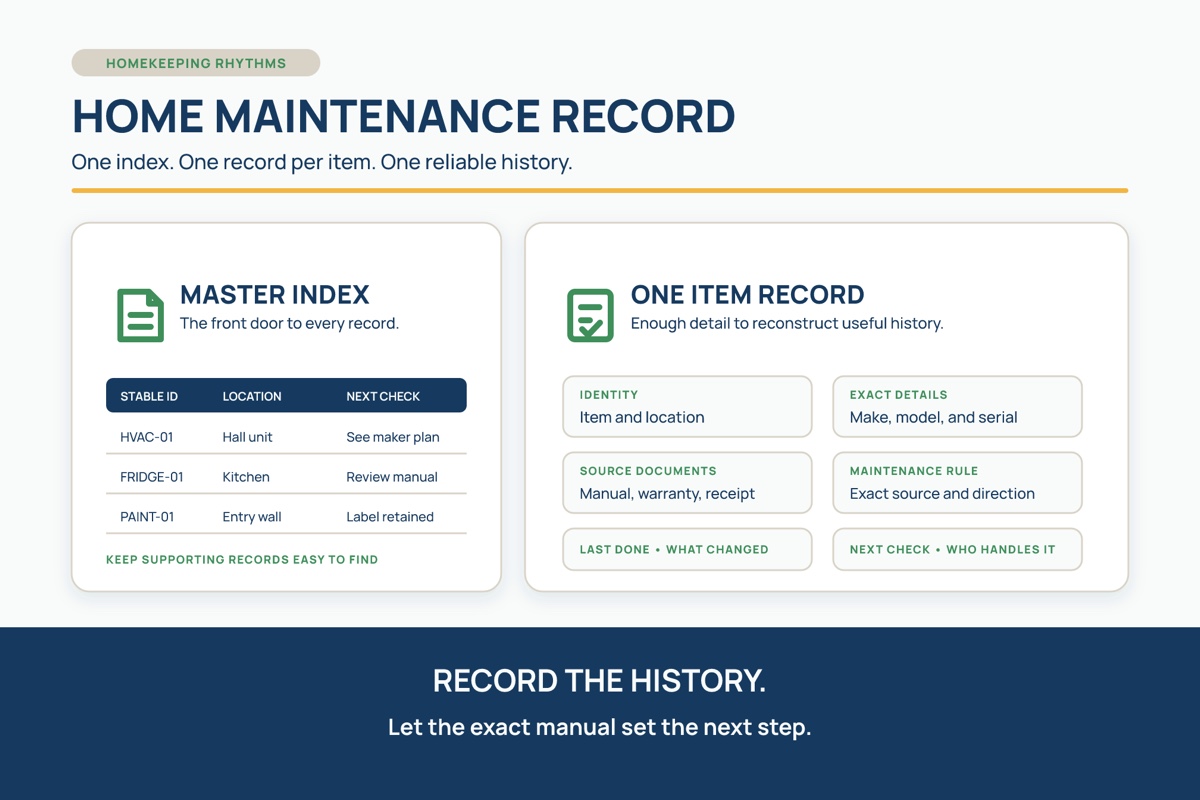
A useful record should answer three questions quickly: What is this item? What has already been done? Where is the exact source that tells me what comes next? If your system can do that, it does not need to be elaborate. It needs one index, one record for each important item or finish, and a simple habit for recording completed work.
Choose one home for the record
Start with the format you are most likely to open while standing near the item. A small binder can work well if you prefer paper. A clearly named folder with a simple spreadsheet or document can work well if you prefer digital records. A hybrid system is also practical: keep the index digitally, then note the folder, envelope, or file where each original document lives.
Use one primary home instead of maintaining several competing versions. If another household member may need the record, choose a location and naming pattern that both of you can understand without explanation. Keep passwords, alarm codes, financial account details, door codes, and other sensitive information somewhere appropriately protected rather than placing them in a shared maintenance file.
Build a short master index
The index is the front door to the system. Give each major item or finish a plain, stable name such as “Hall HVAC,” “Kitchen Refrigerator,” “Water Heater,” “Entry Paint,” or “Guest Bath Tile.” If two similar items could be confused, add a short identifier such as “HVAC-01” or “FRIDGE-02.”
For each entry, record the location, maker, model number, serial number when one exists, and the location of the supporting record. Add one next-check field, but do not fill it from a generic online schedule. Use the exact manual, warranty, service agreement, qualified professional, or other controlling source for the item in your home.
A stable item name helps you connect records that arrived at different times. The manual, receipt, service invoice, filter label, and repair note can all point back to the same entry instead of becoming five unrelated pieces of information.
Keep one record per item or finish
Each item record needs only enough detail to identify the item and reconstruct its useful history. Include the item name and location, maker, model and serial numbers, installation or purchase date when known, and links or file locations for the manual, warranty, receipt, and service agreement.
Then add two working sections. The first is the maintenance rule: the exact source, the directed task, and any interval or condition that source specifies. The second is the history: the date work was completed, what was done, who did it, what part or material was used, and where the invoice or photograph is stored.
Do not copy an entire manual into the record. Link to or file the official document, then summarize only the line you need to act on. If directions change, the source document remains more reliable than a sentence copied years earlier.
Record completed work while the details are fresh
After maintenance or service, add one concise entry before putting the tools or paperwork away. Write the date, the exact task, any model-specific part or filter information, the service provider when applicable, and the next check directed by the controlling source. Note an unusual sound, leak, finish change, error code, or unresolved concern without trying to diagnose it in the record.
A maintenance history is evidence, not a promise that an item is safe or sound. Stop using equipment and follow the maker’s safety directions when a warning, recall, damage, odor, leak, electrical problem, combustion concern, or other hazardous condition appears. Use a qualified professional when the manual, warranty, code, or scope of work requires one.
Keep warranties and proof together
The Federal Trade Commission advises saving a copy of a written warranty and the product receipt. The receipt can establish when the product was purchased and that you are the original owner. Record where those documents live, the stated coverage period, and the claim contact, but keep the complete warranty language because a short note cannot capture every limit or condition.
Keep a warranty separate from an extended warranty or service contract in your index. The FTC explains that a service contract is different from a warranty that may come with a product. Naming the document accurately makes it easier to see which company, terms, dates, and claim process apply.
Give paint and finishes their own records
Paint records deserve more than a color name. Record the brand, product line, color name and code, sheen, room, exact surface, application date, and any primer or special preparation that was used. Save a clear photograph of the label, and note whether a small labeled sample remains.
Apply the same idea to tile, grout, flooring, countertop, cabinet, hardware, roofing, siding, and other finishes. A useful entry identifies the exact material and finish, where it appears, who supplied or installed it, and where the care or warranty directions can be found. Test a touch-up or care method as the manufacturer directs because age, light, wear, and batch differences can affect the result.
Use a five-step setup that can grow slowly
- Choose one primary location. Use a binder, digital folder, or clearly defined hybrid system that the household can find.
- Create the index. Start with five important items, not the whole house, and give each one a stable name.
- Attach the exact sources. Save the manual, warranty, receipt, service agreement, finish label, or qualified guidance that controls the next action.
- Record the useful history. Add completed dates, exact work, parts or materials, provider details, document locations, and unresolved observations.
- Set one next check. Use the controlling source, put the reminder on the calendar you already use, and update the record after the work is complete.
The goal is not to document every nail in the house. Begin with one item that is expensive, safety-sensitive, easy to confuse, or maintained more than once. A small record that answers the next real question is already doing its job. Each completed task can make the system a little more useful, one trustworthy line at a time.
The minimum useful record
For each appliance or system, record five things:
- what the item is and where it is;
- the model, serial, or filter information you can verify;
- what was done and when;
- which manual, label, invoice, or professional supplied the information; and
- what should happen next, if anything.
Photographs are useful when they preserve a model plate, control panel, filter size, or condition before service. They are records, not repair instructions. Keep the system simple enough that you will update it after the next small maintenance event.
With care,
Hazel