What Twenty Years in Spicewood Has Taught Me to Notice
October 27, 2026
When I came to Spicewood approximately twenty years ago, it felt distinctly rural and separate from Austin. I remember beautiful Hill Country land, wildlife, and long stretches that had not yet been divided into lots.
Over time, I have watched some of those stretches change.
What I can say from watching
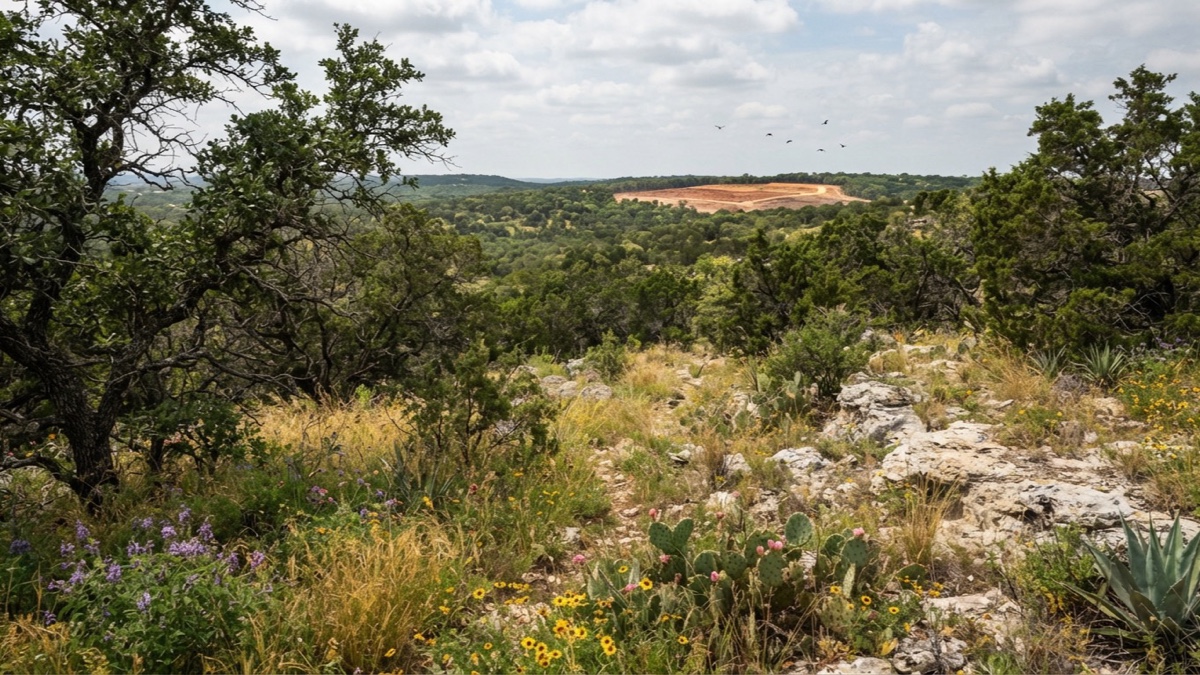
I have watched Hill Country land cleared down to bare soil before housing and commercial construction. The first change is not a finished building. It is the sudden absence of the varied landscape that had been there.
Later come neighborhoods, commercial strips, gas stations, car lots, and concrete. People who arrive after construction see what was added. People who watched the clearing also remember what was removed.
I love and thrive in nature. In another life, I sometimes think I might have become a wildlife biologist. Long attention has taught me to notice absence: a familiar view changed, a hill cleared, or a once-distinct edge of town beginning to resemble many others.
Building and belonging can share the same question
I spent part of my professional life designing new homes. I understand the desire to build, and I am proud of the thoughtful work I did for families. People need places to live. Communities change. New residents are not the enemy, and no single household carries the whole responsibility for regional growth.
The question is not whether all building is wrong. It is whether a project begins by looking carefully at what is already there. Which trees can remain? Can an existing structure be adapted? How will water move across the site? What gives this place its particular character?
Those questions do not settle every planning decision. They do make it harder to treat living land as a blank page.
Memory is part of stewardship
A visitor can see a beautiful view without knowing what stood nearby ten years earlier. A person who has watched a place for decades carries another layer of information. Memory becomes an informal map.
That memory should not become a reason to reject everyone who arrives later. It can become a reason to teach what makes a place distinct, support thoughtful planning, and keep asking whether growth can respond to the Hill Country instead of making it generic.
Twenty years in Spicewood has taught me that stewardship begins before construction and before landscaping. It begins by looking closely enough to understand that the land was never empty.
With love and intention,
Jennifer