Find the Hardest Moment in One Room and Soften It
August 30, 2026
A room can be tidy and still be difficult to use. The chair catches the closet door. The lamp switch is out of reach once you sit down. Clean laundry reaches the bedroom but has nowhere to pause before it is put away. The everyday bag lands on the floor because the intended hook is behind another door.
These are small moments, but repetition gives them weight. Instead of reorganizing the whole room, choose the one moment that makes you sigh, step around something, set an item in the wrong place, or leave a simple task unfinished. Then change only what contributes to that moment.
Watch the room in use before changing it
Pick one room and observe it through one ordinary part of the day. Notice where movement slows, where hands become full, where an object repeatedly lands, where a door or drawer cannot open easily, or where a task requires an unnecessary trip.
Describe the moment as an action rather than a verdict. “The room is a mess” is too broad to guide a useful change. “I have to move the laundry basket before I can open the closet” identifies a place, an object, and a repeatable conflict.
If the difficulty changes from day to day, keep a short note for several uses. You are looking for a pattern, not trying to correct every inconvenience at once.
Name the actual obstacle
The first explanation is not always the most useful one. A pile near the door may look like a storage problem, but the harder moment might be arriving with both hands full and no open landing place. A dim corner may look decorative, but the difficulty might be reading a label, finding a dropped item, or moving through the room after sunset.
Ask what the moment needs: a landing place, better light, more clearance, a reachable seat or surface, a shorter sequence, or a different location for one frequently used object. Also ask who uses the room and whether the change would create a new obstacle for someone else.
North Carolina State University’s Center for Universal Design describes usable environments as simple and intuitive, low in physical effort, and generous enough in size and space for approach and use. Those principles were developed for broad design practice, not as a decorating formula, but they offer a helpful question for an ordinary room: can the needed action be easier to understand, reach, and complete?
Choose the smallest change that addresses the moment
A good first change is specific and reversible. Move the empty basket to the side where laundry actually arrives. Clear enough space for the closet door to open fully. Place a stable tray where keys are already set down. Move a frequently used item from a deep cabinet to an accessible shelf. Reposition a lamp only if the cord, fixture rating, outlet, walkway, and manufacturer’s directions allow it.
Do not solve an inconvenience by creating a hazard. Keep doors, exits, stairs, heating equipment, electrical panels, appliance ventilation, controls, and established walking paths clear. Do not add an extension cord, overloaded hook, unstable stool, top-heavy shelf, or storage above a heat source as a quick fix. Structural, electrical, lighting, accessibility, repair, and mobility concerns may need a qualified professional or a more complete household decision.
The purpose is not to make the room look finished. It is to support one repeated action with less lifting, reaching, backtracking, obstruction, or guesswork.
Test the change in real life
Use the room normally for several days before buying a permanent organizer or changing anything else. Did the hard moment become easier? Did the object return to its place without extra thought? Can every person who uses the room still reach what they need and move through the space comfortably?
If the change helped only once, the obstacle may have been named too broadly. If it helped one person but blocked another, the location or method needs adjustment. If it created clutter somewhere else, follow the object to its new stopping point and reconsider the whole sequence.
Keep a change that genuinely improves the repeated moment. Reverse one that does not. A useful test protects you from building an elaborate system around a guess.
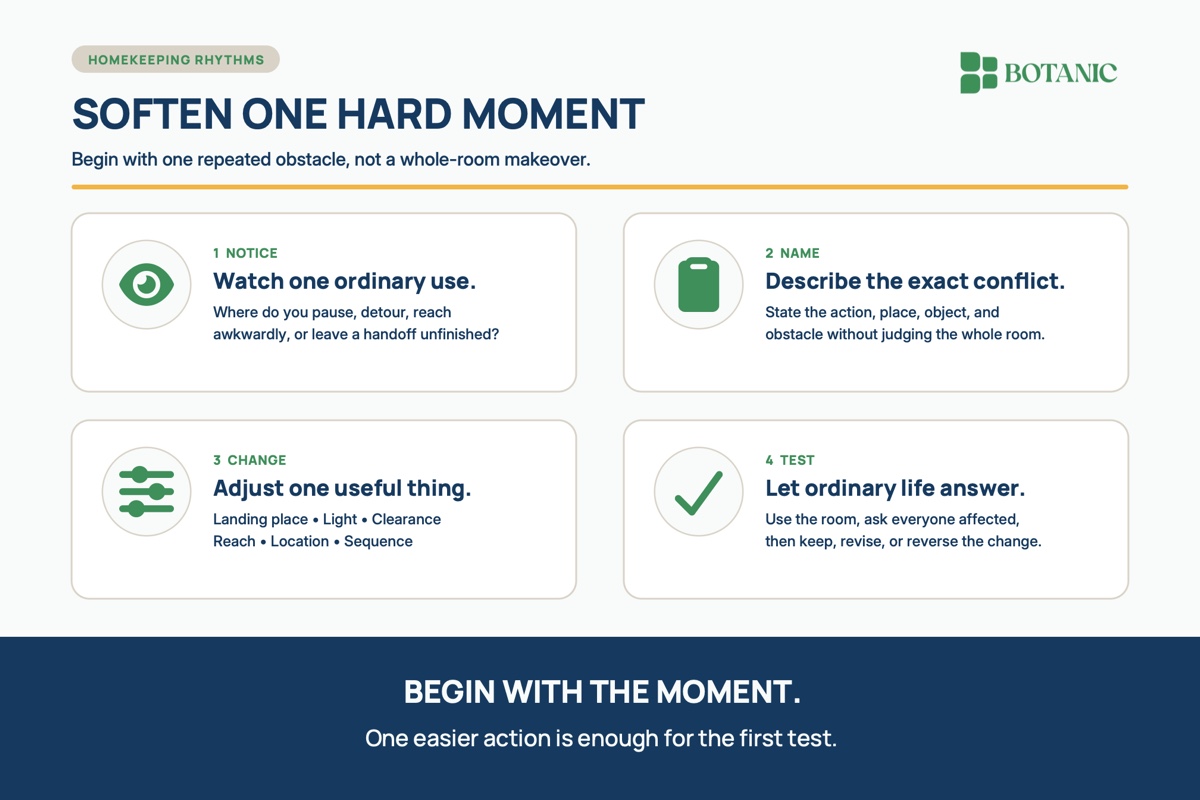
A four-step room-friction map
- Notice one moment. Watch for the repeated sigh, detour, blocked opening, awkward reach, full hands, or unfinished handoff.
- Name the obstacle. State the exact action, place, object, and conflict without judging the entire room.
- Choose one change. Adjust a landing place, light, clearance, reach, location, or sequence while preserving safety and access.
- Test real use. Live with the change for several days, ask everyone affected, and keep, revise, or reverse it.
Let one easier moment be enough
A home does not have to be optimized in every corner to support daily life well. One door that opens without a detour, one lamp that can be reached from the chair, or one basket that receives what used to land on the floor can make a room feel noticeably more cooperative.
When a room feels difficult, begin with the moment rather than the makeover. Notice it, name it, soften it, and let ordinary use tell you whether the change deserves to stay.
With care,
Hazel