
Why Some Plastics Hold Onto Odors
August 20, 2026
You open a clean food container and catch yesterday’s tomato sauce. A reusable bottle still carries a trace of coffee. A silicone-edged lid smells stronger than the clear base it fits. The item may look clean, yet your nose says something remains.
That lingering odor does not have one universal cause. It may come from a thin film on the surface, residue in a seam or removable seal, aroma compounds that have interacted with the plastic itself, or a material that has become scratched, warped, rough, or otherwise changed. The useful question is not simply, “How do I cover the smell?” It is, “Where is the odor likely to be, and can this item still be cleaned for its intended use?”
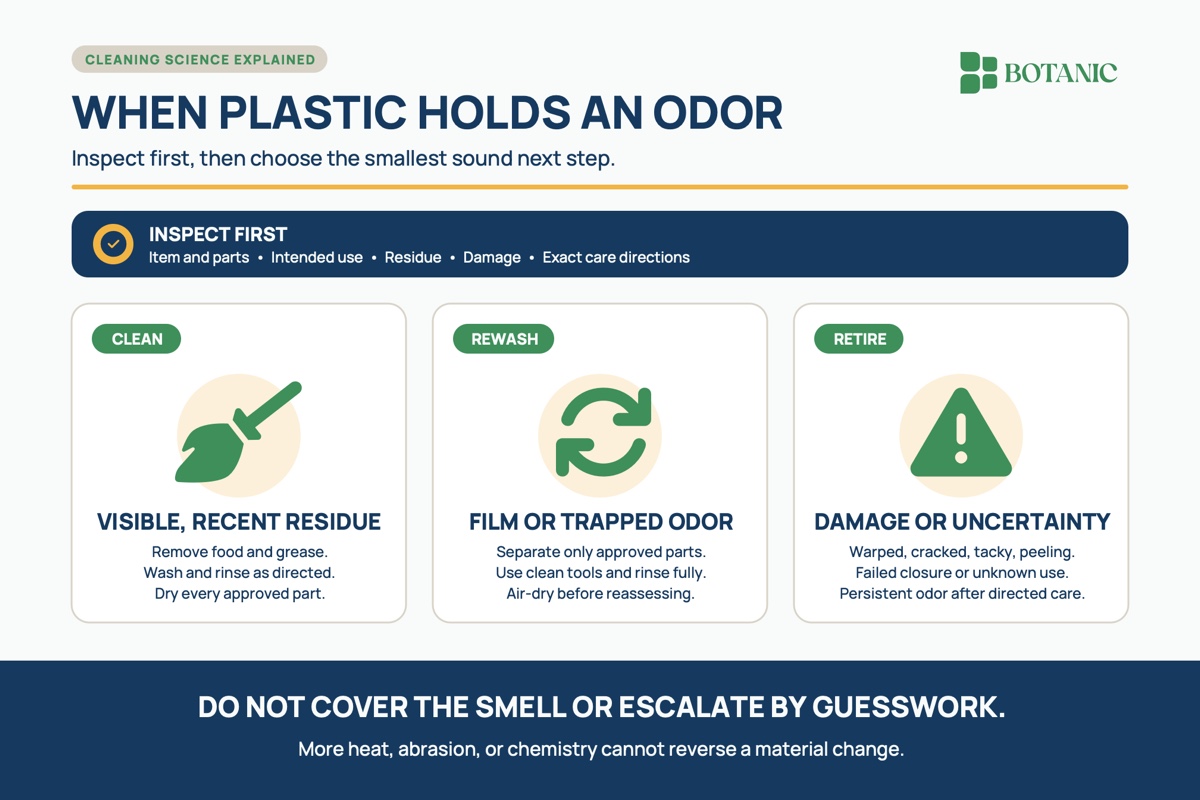
Start with residue before blaming the material
Food oils, sauces, spices, coffee, cleaning product, and other residues can remain in places that a quick wash does not fully reach. Look at lid channels, threads, drinking valves, textured bottoms, corners, hinges, and removable gaskets. A container base and its lid are separate cleaning decisions because they may use different materials and hold residue in different ways.
Use only the disassembly steps the maker provides. A seal designed to lift out for washing should be removed and cleaned as directed. A bonded liner, valve, or insert should not be pried loose simply because a gap is difficult to reach. Damaging a part to clean it can create a new place for residue or keep the item from closing as designed.
The American Cleaning Institute advises removing leftover food and extra grease before washing plastic food containers, then washing with dish soap and warm water or using the dishwasher only when the item is dishwasher safe. It also emphasizes thorough drying. Those ordinary steps matter because deodorizing is unlikely to work well while a removable layer of food, grease, soap, or rinse water is still present.
Some aroma compounds can interact with the plastic
Plastic is not one material. Different polymers and formulations have different structures and different relationships with the substances they contact. Food-packaging research describes “aroma scalping,” a process in which aroma compounds are sorbed into a polymer. The rate and extent depend on the polymer, the aroma compound, the food or liquid, and the conditions of contact.
At a household scale, this helps explain why two containers used for the same meal may not smell the same after washing. It also explains why an intact item can sometimes retain an odor even after visible residue is gone. The smell is not necessarily sitting on top of the surface like a crumb. Some volatile compounds may have moved into the material and may later move back toward the surface or the surrounding air.
This does not mean every plastic item behaves like a sponge, and it does not let us identify a plastic or judge its safety by smell. It means that material, contents, contact time, and condition all matter. A maker’s use and care directions remain more useful than a universal deodorizing recipe.
Temperature changes the decision
Warmth can make volatile odor compounds easier to notice, but adding heat is not a safe universal fix. Before treating a container as dishwasher safe, microwave safe, freezer safe, or suitable for hot food, look for explicit permission in its instructions or markings. A takeout tub, yogurt container, lid, gasket, and purpose-made reusable container may have very different limits.
Do not use boiling water, a hot dishwasher cycle, direct sun, a microwave, an oven, or another heat treatment unless the manufacturer permits it for that exact item and part. If plastic softens, shrinks, loses its shape, becomes cloudy or tacky, or no longer seals correctly, more washing cannot reverse that physical change. The American Cleaning Institute specifically advises retiring single-use containers that cannot hold their shape in hot water or the microwave.
Choose the clean, rewash, or retire path
Clean
Choose a normal cleaning path when the item is intact, the odor source is recent and known, and you can see food, grease, or another permitted-use residue. Empty it promptly. Remove loose material and extra grease without scratching the surface. Wash every manufacturer-approved removable part with the directed water temperature, product, tool, and dishwasher placement. Rinse as directed, then dry the base, lid, seal, and channels fully before reassembly.
Rewash
Choose a careful rewash when the first wash left a soap film, grease, trapped water, or odor in a removable part or hidden channel, but the item remains sound. Begin with clean tools and fresh wash water. Recheck the care directions, disassemble only what is meant to come apart, and clean each component separately. Rinse thoroughly so the cleaning product does not become the next odor, then let every piece dry completely in moving air before you judge the result.
If the maker provides a specific stain or odor treatment, follow its exact formula, time, rinsing, ventilation, and compatibility limits. Do not combine vinegar, bleach, ammonia, peroxide, baking soda, detergent, or another household product unless the labels and manufacturer instructions explicitly support the combination. Never mix chlorine bleach with ammonia, acids, or other cleaners.
Retire
Pause the item’s original use when it is cracked, deeply scratched, warped, peeling, tacky, roughened, permanently cloudy in a way the maker treats as damage, or no longer closes as designed. The same pause is sensible when an unknown odor returns immediately after a complete directed wash and dry, or when the item held a substance outside its intended use.
For a food-contact item, contact the manufacturer when you are unsure whether the condition is acceptable. Replace it when the maker directs replacement or when you cannot clean and inspect it with confidence. Do not repurpose a questionable food container for medicine, pet food, children’s items, or a chemical that requires a purpose-made labeled container. Recycling or disposal options depend on the exact material and local program, so check locally rather than relying on the resin number alone.
Odor is information, not a safety test
A strong smell can alert you to residue, spoilage, or material change, but the absence of smell does not prove that food is safe. The U.S. Food and Drug Administration notes that foodborne pathogens can be present even when food does not look, smell, or taste spoiled. Evaluate the food by its storage time, temperature, handling, and official guidance. Evaluate the container separately by its intended use, condition, cleaning directions, and whether it can be fully cleaned and dried.
The practical rule is to move in order: remove residue, clean every permitted part, rinse, dry, and reassess. If the odor remains but the item is sound, use only the maker’s supported next step. If the material has changed or the original use is no longer clear, retirement is a sound care decision, not a failed cleaning effort.
With care,
Hazel