How to Read a Botanic Cleanser Product Page
August 21, 2026
A product page can answer several useful questions before you choose or use a household cleanser. It can identify the exact formula, name the jobs the product is presented for, describe the soils it is intended to help remove, and disclose ingredients. It can also leave practical questions unanswered.
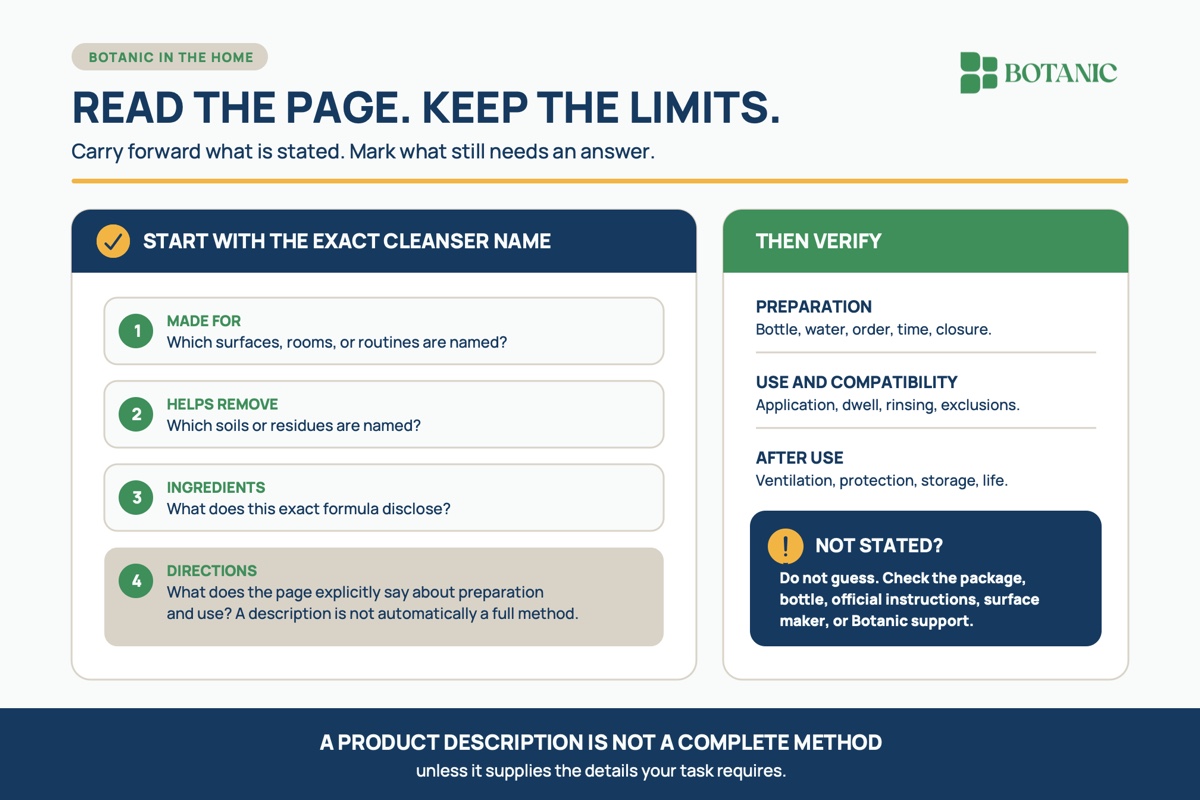
Reading well means keeping those two things separate. Treat every statement on the page as a specific piece of information, not as permission to fill the spaces between statements with assumptions.
Start with the exact product identity
Read the full product name before the broader description. Botanic currently has distinct All-Purpose, Glass and Mirror, Bathroom, Kitchen, Floor, Stainless Steel, Heavy Duty, and Auto and Marine tablet formulas. Similar packaging or a shared tablet format does not make those formulas interchangeable.
Keep the formula name connected to its matching tablet, bottle, package directions, and saved product page. Do not shorten the decision to “a Botanic tablet” when the task depends on which cleanser you actually have.
Separate the stated job from the stated soil
Many current Botanic cleanser pages use two helpful fields: “Made for” and “Helps remove.” They answer different questions. “Made for” describes the surfaces, rooms, or routines named on the listing. “Helps remove” describes soil such as dust, fingerprints, grime, grease, smudges, residue, or buildup.
Neither field is a complete use direction. A named room does not mean every material in that room is compatible. A named soil does not promise that every mark will come off, authorize stronger scrubbing, or turn cosmetic damage into removable dirt. Check the exact surface maker’s care instructions, finish, condition, and warranty before applying any cleaner.
Read the ingredient list as a disclosure, not a recipe
An ingredient list tells you what the current page discloses for that formula. Botanic’s Ingredient Spotlight library can provide more context about individual ingredients and the roles they may play in cleaning performance, tablet function, chelation, surfactant action, or color.
That education does not supply missing product directions. An ingredient article does not tell you to increase the concentration, combine the cleanser with another product, substitute a raw ingredient, or use the formula on a surface the product page does not name. The complete formula behaves as a system, and the current product instructions remain controlling.
Look specifically for use directions and limits
After you understand the product’s identity and stated purpose, search for the details that turn a description into a usable method. Depending on the task, you may need the exact water amount and temperature, preparation order, dissolving time, bottle requirement, application method, dwell time, agitation, rinsing, ventilation, protective equipment, food-contact guidance, surface exclusions, testing direction, storage conditions, and prepared-solution life.
Do not assume that a product page contains all of those fields. As reviewed on August 6, 2026, the current All-Purpose tablet page says to add water and identifies countertops, touch points, sealed hard surfaces, everyday cleaning, several common soils, and a disclosed ingredient list. It does not state an exact water volume or temperature, dissolving time, application amount, rinsing direction, surface-exclusion list, ventilation or protective-equipment direction, or prepared-solution storage life.
Those missing details are not an invitation to borrow instructions from another formula, estimate from the bottle, or use a social post as the label. Check the physical package and bottle, the current official product information supplied with the order, and any formula-specific instructions. If the needed answer is still absent, contact Botanic support before preparing or using the cleanser.
Do not promote a cleaning claim into a different claim
A product described as a cleaner should be treated as a cleaner unless its current directions and claims establish something more. The Centers for Disease Control and Prevention distinguishes cleaning, sanitizing, and disinfecting and advises using a product suitable for the surface while following its label. A statement about removing dirt, fingerprints, grime, grease, or residue is not by itself a sanitizing or disinfecting direction.
The same discipline applies to safety and environmental language. Do not turn “plant-powered,” an ingredient origin statement, a tablet-format benefit, or a reduced-packaging statement into a universal claim about nontoxicity, child safety, pet safety, allergy safety, material compatibility, biodegradability of the complete formula, or environmental superiority.
Use the All-Purpose page as a worked example
- Identity: The page names the product as All-Purpose Cleaner Tablet (1ct). That identifies the formula and count.
- Stated jobs: The page names countertops, touch points, sealed hard surfaces, and everyday cleaning throughout the home.
- Stated soils: The page says the product helps remove dust, grime, fingerprints, and light grease.
- Ingredients: The page provides a formula-specific ingredient disclosure. Related Ingredient Spotlight articles can explain several of those ingredient types.
- Preparation statement: The description says to add water. The broader Botanic product-information page gives the sequence of filling the reusable Botanic bottle with water, adding the tablet, allowing it to dissolve fully, and then cleaning.
- Unanswered questions: The current page record does not provide every quantity, timing, application, compatibility, rinsing, storage, or protective detail a particular task may require. Those questions stay open until an official direction answers them.
A six-question product-page check
- What is the exact product and formula?
- Which surfaces, rooms, or routines does the page actually name?
- Which soils does it say the cleanser helps remove?
- Which ingredients are disclosed, and which official ingredient articles add context?
- Which preparation, application, rinsing, safety, and storage directions are explicitly stated?
- Which details remain unanswered and must be checked on the package, bottle, current official instructions, surface-maker guidance, or with Botanic support?
The most trustworthy way to use a product page is to let it be exact. Carry forward what it states, mark what it does not state, and pause when the missing piece affects preparation, compatibility, safety, or care. That simple reading habit protects the difference between product information and a guess.
With care,
Hazel