
Snake Plants in Every Room
September 10, 2026
I have been playing with snake plants since college. I was studying plant and soil science then, and one of my required courses was a propagation lab. We worked with snake plants often, taking cuttings and learning how to grow entirely new plants from pieces of an established one.
That was my introduction to them. They did not enter my life as a decorating trend or as the answer to an empty corner. I learned them with my hands first: cutting, planting, waiting, and watching for proof that something new had begun beneath the soil.
Years later, they are scattered throughout my house. I have very small ones in little pots and large ones in large pots. There is no carefully planned placement system. My house is already so full of plants that it feels a little like a jungle, and at this point I put a snake plant wherever another plant is not.
Plants are one of my passions. The snake plants have simply become part of the whole house.
What Happened When One of Mine Broke
One of my largest snake plants was a plant I was especially proud of. Then one day my little iRobot vacuum knocked it over. The pot fell, and several of those big, thick, stalk-like leaves broke away. It was badly damaged.
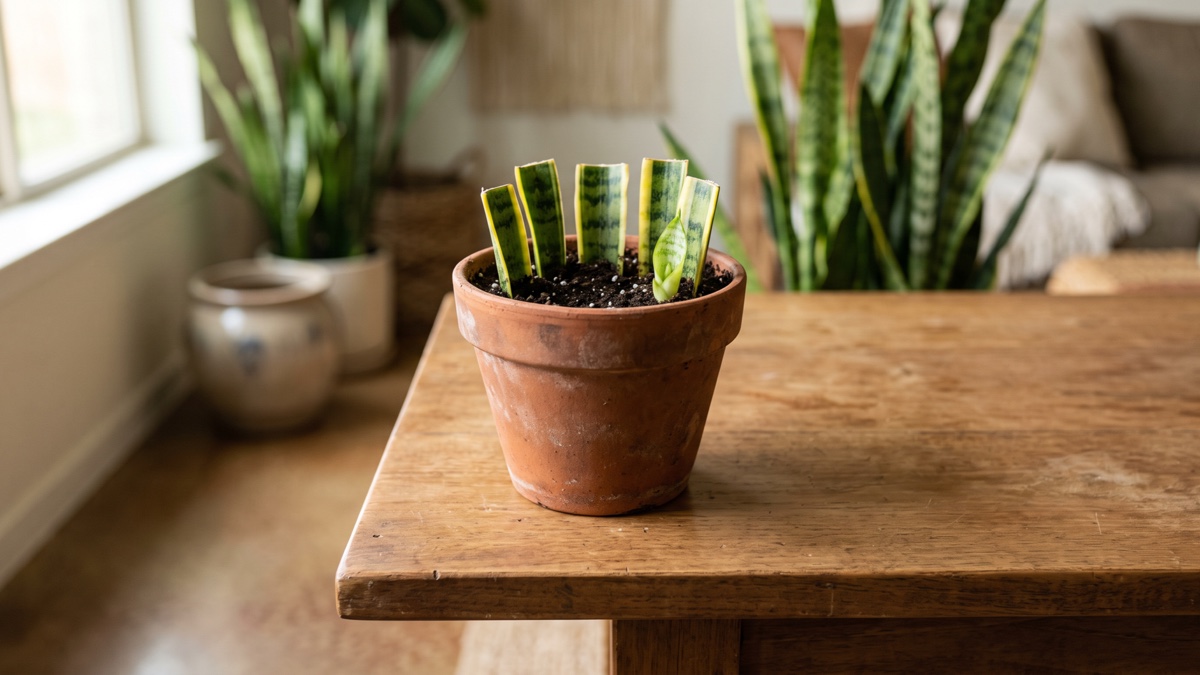
I could have thrown the broken pieces out, but the sight of them brought me straight back to that college propagation lab. I cut the fallen leaves into smaller sections, placed five of them together in a pot, and began watering them.
For several months, nothing seemed to happen. Propagation asks for a particular kind of patience because most of the important work takes place where you cannot see it. I kept watering the pot, but I had almost given up on the cuttings growing properly.
Then, about a month ago, I noticed a brand-new leaf emerging from the base of one cutting.
It was a small sign, but it gave me new hope for all five. I am going to keep tending them until they are established. Then I will move them into smaller pots of their own, scatter them around the house, or give some to friends.
I love passing plants on to people. Whenever a plant breaks and I think I can salvage it, I try. With many plants, I will place a cutting in a jar of water until it grows roots, then replant it. Something that looked like waste becomes a new plant in someone else’s home.
The Benefits I Value Most
Snake plants are now classified botanically as Dracaena trifasciata, though many people still know them by the older name Sansevieria. Their upright leaves give a room height and structure without requiring much floor space. Depending on the variety, the leaves may be deep green, striped, variegated, edged in yellow, or gathered into a shorter rosette.
Their practical strengths matter just as much as their shape. Snake plants tolerate ordinary indoor humidity, a broad range of light, and the occasional missed watering. They generally grow more strongly in brighter indirect light, but they are far more forgiving of imperfect conditions than many houseplants. They also grow slowly enough that they do not constantly demand a larger pot or a new location.
There is not much ceremony involved in caring for mine. I water them when I think about it, usually while I am watering the other plants that actually need more frequent attention. That loose rhythm works because snake plants prefer to dry between waterings. The greater risk is usually too much water rather than too little.
They are also wonderfully generous plants. A mature cluster can be divided, and leaf sections can be rooted to begin new plants. That ease of propagation means one healthy plant can become part of several rooms or several homes over time.
What the Research Really Means at Home
After college, I began reading about the remarkable air-purifying qualities attributed to snake plants. That was part of what made me want to keep them in my home. The idea contains a small piece of real science, but the full story is more nuanced than the popular headlines suggest.
Researchers have shown that plants can absorb certain volatile compounds inside small, sealed laboratory chambers. A normal room is not a sealed test chamber, however. In a real home, an ordinary collection of houseplants does not remove pollutants at a rate comparable to regular air exchange or effective filtration. One major review estimated that it could take roughly 10 to 1,000 plants per square meter of floor space to match the removal already provided by ordinary building air exchange.
That does not diminish what snake plants bring into a home. Their strongest benefits are more tangible: they are durable, easy to live with, simple to propagate, visually beautiful, and capable of bringing living green structure into places that might otherwise feel empty. Research on indoor plants more generally also suggests that seeing and tending plants may support calm, attention, and a sense of well-being, although those findings are not unique to snake plants.
I no longer need to make a dramatic promise about cleaner air to explain why I value them. I can watch them grow. I can notice when they change. I can rescue a broken leaf and wait long enough to see new life appear.
Start With the Easy Ones
My advice to someone who loves plants but believes they are not good at keeping them alive is simple: start with the easy ones.
You do not have to become an accomplished plant keeper before bringing a plant home. Begin with something forgiving. Let it live near you. Notice the soil, the light, the direction of the leaves, and the subtle changes that happen from one week to the next. Simply having plants around can make a person want to give them a little more care.
For a snake plant, the essential rhythm is uncomplicated. Give it a pot and soil that drain well. Let the soil dry before watering again. Place it in the light you have, understanding that brighter indirect light usually supports stronger growth. Wipe dust from the broad leaves when they need it, and watch for the plant’s own signals rather than forcing it onto a rigid calendar.
Over time, the attention becomes more natural. One easy plant may lead to another, then to plants that ask for a little more. Eventually, without realizing exactly when it happened, you become someone who knows how to care for them.
The Layer That Is Alive
I am a designer by education, so I understand the importance of layering elements and materials in a room. Wood, stone, textiles, pottery, books, and collected objects all give a space depth. Plants participate in that layering, but they bring something an object cannot.
They are alive.
You watch them grow. You watch them change. A new leaf appears where there was only soil. A cutting begins to root. A small plant becomes large enough for a new pot, and an empty place in the house fills with something living.
That is what plants give a room. They are more than another design layer. They are the layer that is alive.
With love and intention,
Jennifer