
Why Lake Travis Rises and Falls
August 19, 2026
Lake Travis is the most beautiful lake in Texas. I know I am biased, because I live on it. But I have also been watching it for twenty years, and I have never once seen it look the same two days in a row.
That is not a flaw. It is the design. Lake Travis is not a pond someone landscaped and filled. It is a working reservoir, and its shoreline is the honest record of every wet year and every dry one.
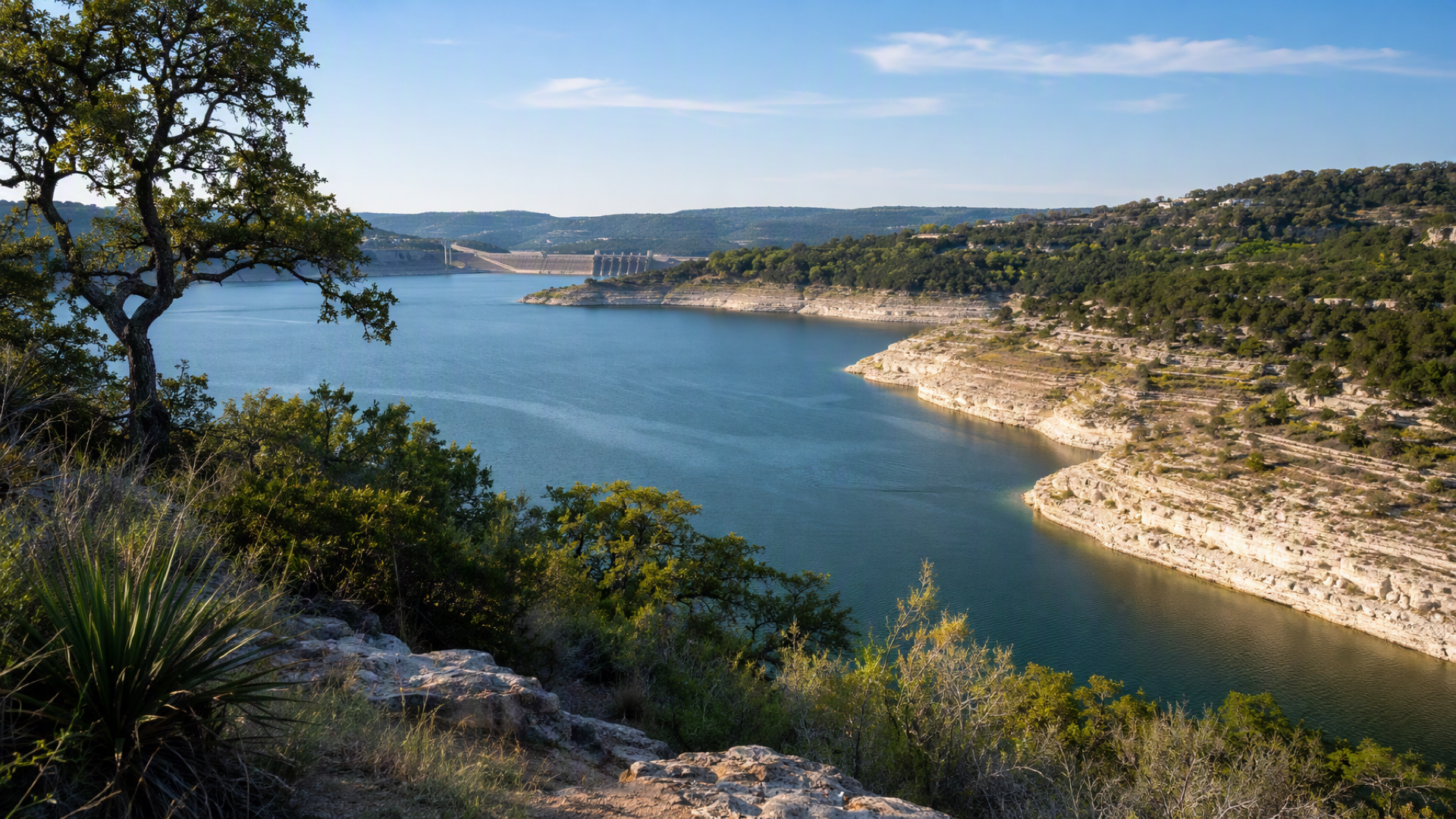
A Lake That Answers to the Sky
Mansfield Dam created Lake Travis on the Colorado River. LCRA treats Lake Travis and Lake Buchanan as the Highland Lakes’ water-supply reservoirs, and both are built to fluctuate. The lake is considered full at 681 feet above mean sea level, with extra room above that line for flood storage. I live here, so I wanted to understand all of it, and the more I learned, the more the waterline made sense.
The rain that falls directly on the lake helps, but it is not the whole story. The lake rises and falls with what the Colorado River and its tributaries bring from upstream. Very dry ground drinks the first rain, and saturated ground sends it running into creeks and rivers. The lake is the last place to hear the news, not the first.
What a Dry Year Shows You
In a dry year you see the truth of the shoreline. The limestone shelves come out, pale and beautiful and sharp. The boat ramps grow longer. Coves you floated in back in June turn into rock gardens by August. The waterline becomes a ruler that measures the thirst of the whole Hill Country.
Some of the water is delivered for municipal, agricultural, and environmental needs. Some of it simply evaporates into the hot Texas wind. Either way, the lake drops, and the dropping shows in every exposed shelf and every lengthened ramp.
What a Wet Year Brings
Then the rain comes back and the lake climbs. The water covers rocks I know by sight. It reaches up into places that had been dry for years. The limestone disappears again, and the lake remembers how to look like a lake.
Recently, the rivers and lakes around the Hill Country took a massive flood of water. Lake Travis came up high, and the flood left things behind along the shore: branches, dock material, pieces of other people’s summers. John and I found a piece of a dock tucked into the shade of the trees, resting on the rocks. It felt like a little fort waiting for us. We set up there for a couple of hours, close enough to jump into the water to cool off and then climb back into the shade.
I think about that afternoon whenever the lake rises. High water is not only caution. It is also memory.
The Lake I Actually Live With
Between the dry years and the wet ones is the lake I actually live with: limestone cliffs, rolling Hill Country hills, coves that collect the light, and rivers feeding in from every direction. On a good day we find a cove with shade from the cliffs, water dripping down the rock, and ferns hanging over the edge. We anchor and float. When the lake is not too busy, we wakesurf. On July 4 we do not hurry anywhere. We cruise slowly and find a calm cove and let the day be simple.
The snacks come from a gas station, everyone picks their own, and whatever fruit is on the counter at home comes along. Fireworks fill the sky from homes, hills, and the little towns around the lake. And by late August the water feels as warm as bath water, and you jump in anyway, because that is what August on Lake Travis is for.
What the Waterline Teaches
Understanding the lake as infrastructure does not make it less beautiful. It makes the beauty more honest. I know why the waterline moves now. It is not a broken promise from the lake. It is a working lake doing its job, and part of the job is waiting.
There is something steadying about living beside a lake that rises and falls. It does not pretend. It does not try to stay full to please anyone. It holds what the year gives it, and when the year is dry, it shows you the limestone and waits. I think we could all learn to wait like that.
Lake Travis is scenery, water supply, flood storage, habitat, and home all at once. Mostly, it is the place where my family makes its summer memories. That is why it rises and falls and still earns its place in our lives.
With love and intention,
Jennifer