
How Often Should You Clean the Washing Machine?
August 26, 2026
A washing machine can look clean from across the room while residue is collecting in places the laundry never touches directly. The dispenser, door seal, tub, drain-pump filter, and other accessible parts may each have their own care instructions. That is why the most reliable answer to “How often?” is not one universal number.
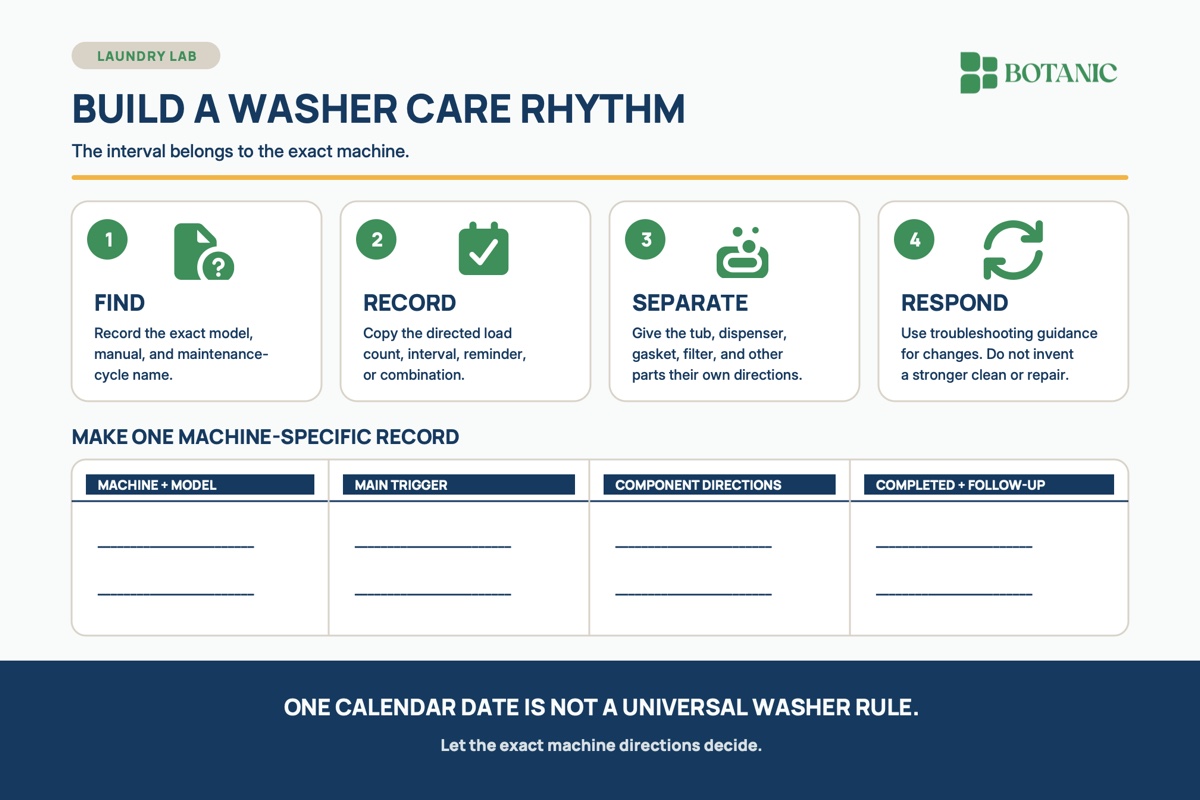
Your washer’s manual is the calendar. Some machines count loads and display a cleaning reminder. Some call for a tub-clean or self-clean cycle on a time-based schedule. Some assign separate intervals to the dispenser, filter, gasket, or inlet screens. The useful goal is to capture those directions in one small record so maintenance happens when the exact machine calls for it.
Start with the exact model, not a generic washer rule
Find the model number and the current owner’s manual or official care page. A front-loading washer and a top-loading washer from the same brand may use different cycles, products, component-access steps, and reminders. Even similar control panels do not prove that the maintenance procedure is the same.
Write down the manufacturer’s exact name for the maintenance cycle, such as Tub Clean, Self Clean, or Clean Washer. Record whether the machine should be empty, whether a cleaner is required, permitted, or prohibited, and where that cleaner belongs. Keep the directed cycle, amount, ventilation, rinsing, and follow-up steps together. Do not transfer a bleach, vinegar, detergent, tablet, powder, or homemade-mixture instruction from another machine.
Use the machine’s real cue
Look for three possible cues in the manual: a number of loads or cycles, a recurring time interval, or an on-machine reminder. The manufacturer may use one cue or combine them. If your machine counts loads, that count can be more useful than a date because a busy household reaches the maintenance point sooner than a lightly used washer.
If the manual gives both a cycle reminder and a monthly instruction for low use, record both conditions in plain language. For example, your note might say, “Run the named maintenance cycle when the reminder appears, or by the directed monthly interval when the reminder has not appeared.” Keep the wording specific to your model rather than turning it into advice for every washer.
Place the record where you will actually see it. A note inside a laundry cabinet, a line in your home maintenance record, or a recurring calendar item all work. Include the date completed and the next trigger, not just a check mark.
Separate tub care from component care
Running the washer’s maintenance cycle does not automatically complete every care task. The detergent dispenser, door glass, gasket, agitator area, drain-pump filter, inlet screens, exterior controls, or removable parts may have separate directions. Some are meant to be cleaned on a schedule. Others are inspected or cleaned only when the manual describes a condition.
Make one short component list from the exact manual. Beside each item, record the permitted access method, cleaning method, and interval. If a component is not user-serviceable, leave it alone. Unplugging, shutting off water, opening a service panel, moving the appliance, or disconnecting a hose should happen only when the manufacturer directs that step and you can complete it safely.
Let changes prompt an earlier manual check
An unexpected odor, visible residue, standing water, slow draining, repeated error code, leak, damaged gasket, loose part, or new mechanical sound is not a reason to invent a stronger cleaning method. It is a reason to pause, identify the condition, and return to the troubleshooting directions for the exact model.
Routine cleaning cannot repair a failing pump, damaged seal, blocked plumbing line, electrical problem, or installation fault. Stop using the machine when the manual identifies the condition as unsafe, when water is leaking, or when a part appears damaged. Contact the manufacturer or a qualified service provider when the directed user steps do not resolve the problem.
Build a four-line washer care record
- Machine: Record the brand, exact model number, manual link, and maintenance-cycle name.
- Main trigger: Copy the directed load count, time interval, reminder, or combination of cues.
- Separate components: List only the user-accessible parts and intervals named for that model.
- Completion: Record the date, the cue that prompted the task, what you did, and any condition that needs follow-up.
A washing-machine schedule should make care more precise, not more complicated. Start with the exact manual, copy the real trigger, and keep tub care separate from component care. Once those four lines are recorded, the machine can tell you when the next useful check belongs.
Think in maintenance zones
A washer is not one surface. Depending on the model, the care routine may include the drum or cleaning cycle, detergent dispenser, door seal, lid or door, exterior, drain area, and a user-serviceable filter. The manual decides which parts you may clean, remove, or access.
Work from the visible and accessible areas first. Remove residue without sharp tools, use only a permitted product or cycle, and leave the parts that can dry open or wiped according to the appliance instructions. Do not improvise a chemical combination because the machine smells stale.
If the machine leaks, fails to drain, shows an error, or has a damaged seal, this is a service question rather than a cleaning experiment.
With care,
Hazel