Why Dust Comes Back So Quickly
August 6, 2026
You dust a shelf, enjoy the clean surface, and notice a new film sooner than seems reasonable. It can feel as if the work did not count. In reality, a freshly cleaned room begins collecting particles again as soon as daily life resumes.
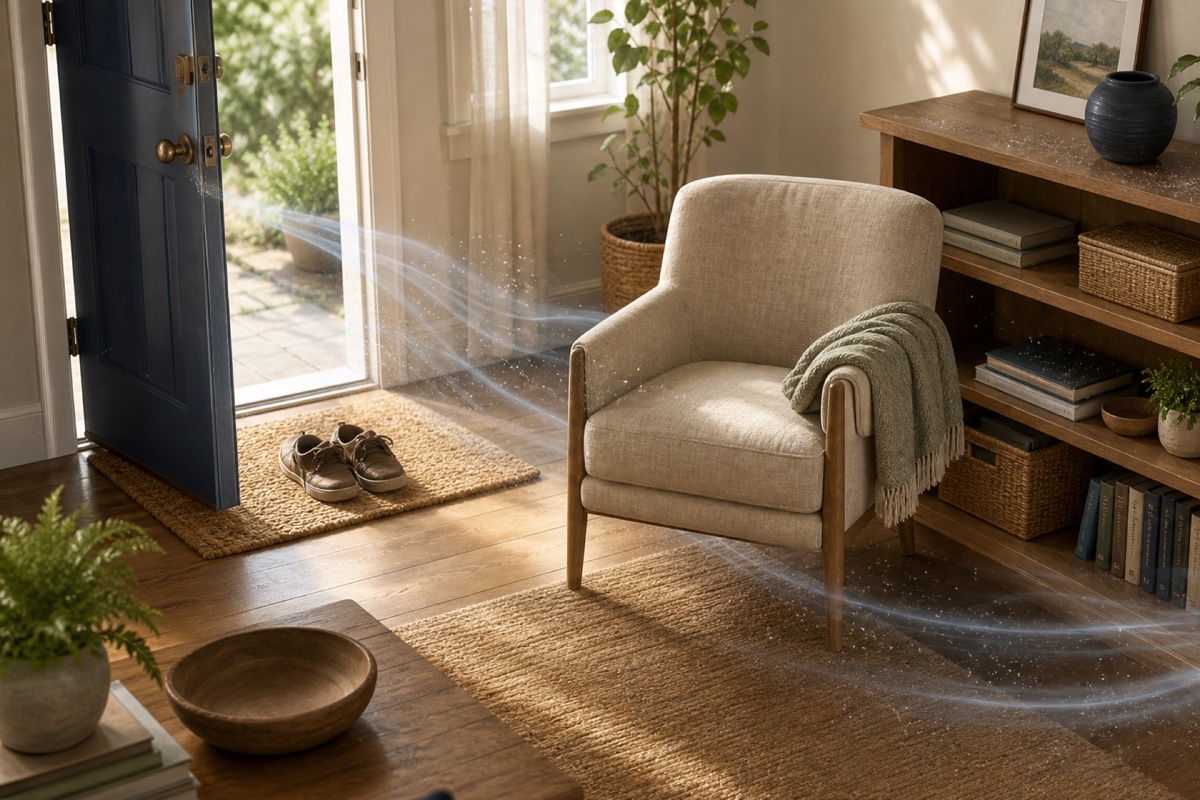
Dust is not one substance with one source. It is a changing mixture of particles that enter from outdoors, come from indoor materials and activities, move through the air, settle on surfaces, and sometimes become airborne again. Understanding that cycle makes dust easier to manage because you can work on its sources and movement instead of repeatedly wiping the same visible shelf.
Dust keeps arriving because a home is active
The U.S. Environmental Protection Agency explains that indoor particles can come from both outdoor air and indoor sources or activities. Home furnishings, cooking, cleaning, and other ordinary parts of household life can contribute particles to indoor air. Open doors and windows, gaps around the building, and people moving in and out also connect the indoor environment with outdoors.
This does not mean a lived-in home is unusually dirty. It means the home is not a sealed display case. Air moves. Fabrics and furnishings are used. Meals are prepared. Shoes, bags, packages, people, and pets travel through rooms. Some particles remain airborne for a time, while others land on floors, shelves, ledges, and objects.
The dust cycle has four parts
1. Particles enter or are released
Some particles arrive with outdoor air or on items moving through an entry. Others come from indoor sources and activities. The mix is different in every home and can change from one day to another depending on weather, open windows, cooking, projects, occupancy, and how rooms are used.
2. Air and activity move them
Walking, opening doors, handling textiles, running fans, and using heating or cooling equipment can move air through a room. A laboratory study indexed by the National Library of Medicine found that walking on a dust-loaded carpet increased airborne particle concentrations in the test chamber. The useful household lesson is simple: dust already on a floor or textile does not always stay there when the room becomes active again.
3. Particles settle on available surfaces
Once movement slows, some airborne particles settle. Broad horizontal surfaces such as shelves, table tops, headboards, appliance tops, and floor edges make easy landing places. A dark, glossy, or strongly lit surface may appear dusty sooner because the contrast makes a small amount easier to see. That visible film is not necessarily proof that the surface attracts all the dust in the room. It may simply reveal what a lighter or more textured surface hides.
4. Particles can be stirred up again
Dry sweeping, a loaded dusting tool, brisk movement across a dusty floor, or shaking a textile indoors can move some settled material back into the air. It may then land somewhere you already cleaned. This is why a fast pass that only redistributes loose dust can look successful for a few minutes without changing the room’s overall dust load very much.
Why certain areas collect dust faster
Look at the room as a pattern rather than judging each surface separately. Entry-adjacent floors receive frequent traffic. Shelves near an upholstered chair or frequently handled throw may sit close to indoor particle sources. Ledges near moving air may collect what passes through that route. Areas behind furniture can hold settled dust until the furniture moves, while open tables show every new layer.
Height also matters to the cleaning sequence. Dust loosened from a high shelf can fall onto a lower surface or floor. If you vacuum first and dust afterward, some of the material may end up back on the floor you just finished. Working from higher surfaces toward lower ones gives loosened particles a final place to land before the floor is cleaned.
A better dusting rhythm captures more and chases less
Begin with the places where particles enter, collect, or are released most often. Keep an easy-to-clean landing area at the main entry, and care for mats, rugs, curtains, throws, and upholstery according to their labels and manufacturer directions. If you use a furnace, HVAC, vacuum, or portable air-cleaner filter, inspect and replace or clean it only as its maker directs. A filter that is the wrong type, installed poorly, overloaded, or incompatible with the equipment is not an improvement.
When it is time to clean a room, use this order:
- Pause active air movement when appropriate. If a portable fan is blowing directly across the work area, turn it off before dusting when doing so is safe and practical. Do not interrupt ventilation required for a cooking, moisture, or product-safety task.
- Start with the highest reachable dusty surfaces. Follow the item’s care guidance, use a stable position, and leave unsafe heights to someone with suitable equipment or training.
- Use a clean tool that captures dust. Choose a soft cloth, vacuum attachment, or other method permitted for the material. Apply any cleaning product according to its label, and avoid spraying liquid into electronics, vents, unfinished edges, or delicate finishes.
- Refresh the tool before it becomes loaded. Refold or replace a cloth, empty the vacuum as directed, and clean reusable attachments according to their instructions so collected soil does not travel to the next surface.
- Finish with the floor. Vacuum, sweep, or damp-clean according to the flooring and equipment instructions after higher surfaces are complete.
Work on the fastest-returning zones between full-room cleanings. A quick weekly pass over one entry floor, a dark media console, and the shelf beside a frequently used chair may be more useful than re-dusting every object on an arbitrary schedule. Let the room show you where the cycle is most active.
Filtration can help, but it cannot make a home dust-free
The EPA states that portable air cleaners and HVAC filters can reduce indoor air pollution, but they cannot remove every pollutant from the air. HVAC filters also work only while the system is operating. Filtration is a supplement to source control and appropriate ventilation, not a replacement for routine surface cleaning.
Choose and maintain any filter according to the equipment maker’s instructions. If you are considering a higher-efficiency HVAC filter, confirm what the system fan and filter slot can accommodate. A qualified HVAC professional can help when the equipment documentation is unclear. Avoid assuming that a more restrictive filter is automatically compatible with every system.
Pay attention when the pattern changes suddenly
A familiar, gradual return of household dust is different from a sudden heavy deposit, visible material blowing from a vent, residue that appears after construction or sanding, or particles associated with damaged building material. Do not dry-sweep or disturb an unidentified material. Pause the cleaning task, identify the likely source, and seek qualified building, HVAC, restoration, or environmental guidance when the situation falls outside ordinary housekeeping.
The practical goal is not to keep every surface dust-free at every moment. It is to slow the cycle, capture more of what you remove, and concentrate your effort where dust returns fastest. When the film appears again, treat it as information about how the room is used rather than evidence that your last cleaning failed.
With care,
Hazel